


The ghost of a chicken: Francis Bacon, faith and scientific method
A sermon by Canon Kenneth Padley
Sunday 7 June 2026
2026 marks the four hundredth anniversary of the death of Francis Bacon – philosopher, politician and lawyer – and one of the most influential Englishmen of all time. According to legend, Bacon met his fate while travelling from London to his country estate in Hertfordshire when he was inspired to test a theory that meat could be preserved if kept cool. He stopped at a cottage, bought a hen, and stuffed it with snow.
Chicken and Bacon are usually a good combination – but not on this occasion. The vain attempt of Lord Francis to invent the fridge-freezer set off a chill, which developed into pneumonia, and from which he died a few days later.
This story of Bacon’s demise is probably as accurate as sightings of the ghost of his plucked chicken which purportedly still haunt Pond Square in Highgate. That said, the tale is consonant with the life of a man who has been hailed as the Father of Modern Science. So what do we actually know about Francis Bacon, what is his enduring legacy, and what is his relevance to Christian faith four centuries later?
Bacon was born in the early years of the reign of Elizabeth I. Contrary to another myth, he was not the secret lovechild of the young queen, but son of Nicholas Bacon and Anne Cooke, nouveau riche who had risen to wealth and influence on the treacherous tides of the Tudor Reformation. Francis enjoyed a typical upbringing for a contemporary of his means: steeped in the Reformed Protestantism which dominated late sixteenth-century England and sent off to Cambridge and Grays Inn for formation in the law. He became a Member of Parliament in his early twenties and later assumed high government office including the posts of Attorney General and Lord Chancellor in the 1610s. He finally fell from royal favour in 1621 as a result of court intrigues surrounding the King’s boyfriend George Villiers.
Complementing his public career, Bacon was a prodigious writer. It is yet more myth that he authored the plays attributed to William Shakespeare; however, he did write about scientific method. In this field his most significant publication was a book called Novum Organum, published in 1620. Novum Organum was an attempt to invert the similarly titled Organon of the Greek philosopher Aristotle written two thousand years earlier.
Aristotle argued from big to small, starting with general principles and then classifying things in ever greater detail. Bacon reversed the process, starting from small observations of world and arguing up to general axioms. We have already seen one example of this in what he tried to learn from a single frozen chicken about the general effect of temperature on the speed of putrefaction.
In line with this ‘inductive’ method of research, Bacon became increasingly interested in chemical and mechanical experiments, and in the creation of new scientific instruments. He urged the government to adopt and promote such developments as a means of boosting English influence abroad. Thus, although it is yet another Baconian myth that he coined the memorable catchphrase ‘knowledge is power’, he might as well have done. Half a century later, Thomas Sprat claimed Bacon’s methodology as undergirding all the scientific goals and work of the newly founded Royal Society:
Bacon like Moses led us forth at last
The barren wilderness he past
Did on the very border stand
Of the blessed promised land
And from the mountain-top of his exalted wit
Saw it himself and showed us it.[1]
In this poem, Sprat exposes the totemic status which Bacon had achieved within a few decades of his death: many groups and individuals of differing views and values have tried to claim his legacy, sought his credentials to reinforce their own ideologies.
Some might take this to an extreme and attempt to trace a direct line of influence from Bacon’s inductive reasoning to deregulated industrialization, to expansionist imperialism, or to nihilistic atheism. But to choose any of these roads would ignore the fact that Bacon was a man of faith.
Bacon’s intellectual revolution has not obliterated the Christian outlook on the world. However, it has changed that outlook and, I suggest, changed it for the better. There are mercifully few twenty first century Christians who advocate ‘blind faith’. This is because we no longer accept Aristotle’s arguments from big to small: we need to build up the bigger picture from evidence rather than make wild claims such as ‘you’ve just got to believe it’.
This is why most thinking Christians have replaced the simplicity of blind faith with a more informed approach. Biblical studies since the seventeenth century have adopted modern critical techniques to scrutinise the historical origins of Scriptural narrative. And much ink has been spilled since the nineteenth century about the impact of scientific advances on how intelligent Christians might understand the world. Neither development has overthrown faith, but each has reshaped how faith is expressed.
I think this is very much in the spirit of Baconian enquiry: Lord Francis was not a cold logician but a man of creativity and fun. We get a glimpse of this in his posthumous monument which rests in the sanctuary of the blessed church of St Michael in St Albans. (It is another false assertion that Bacon is buried in St Michael’s. He might be. He might not. We just don’t know.) What is important about the monument is that it depicts Bacon seated and appropriately deep in thought. But he is also luxuriously dressed and laid back; here is a person of relaxation and fun. The impression left by the monument is a man of creativity as well as contemplation – a combination of the artistic right brain as well as the analytical left. Just such interdisciplinary conversation is needed for rounded individuals and a flourishing society.
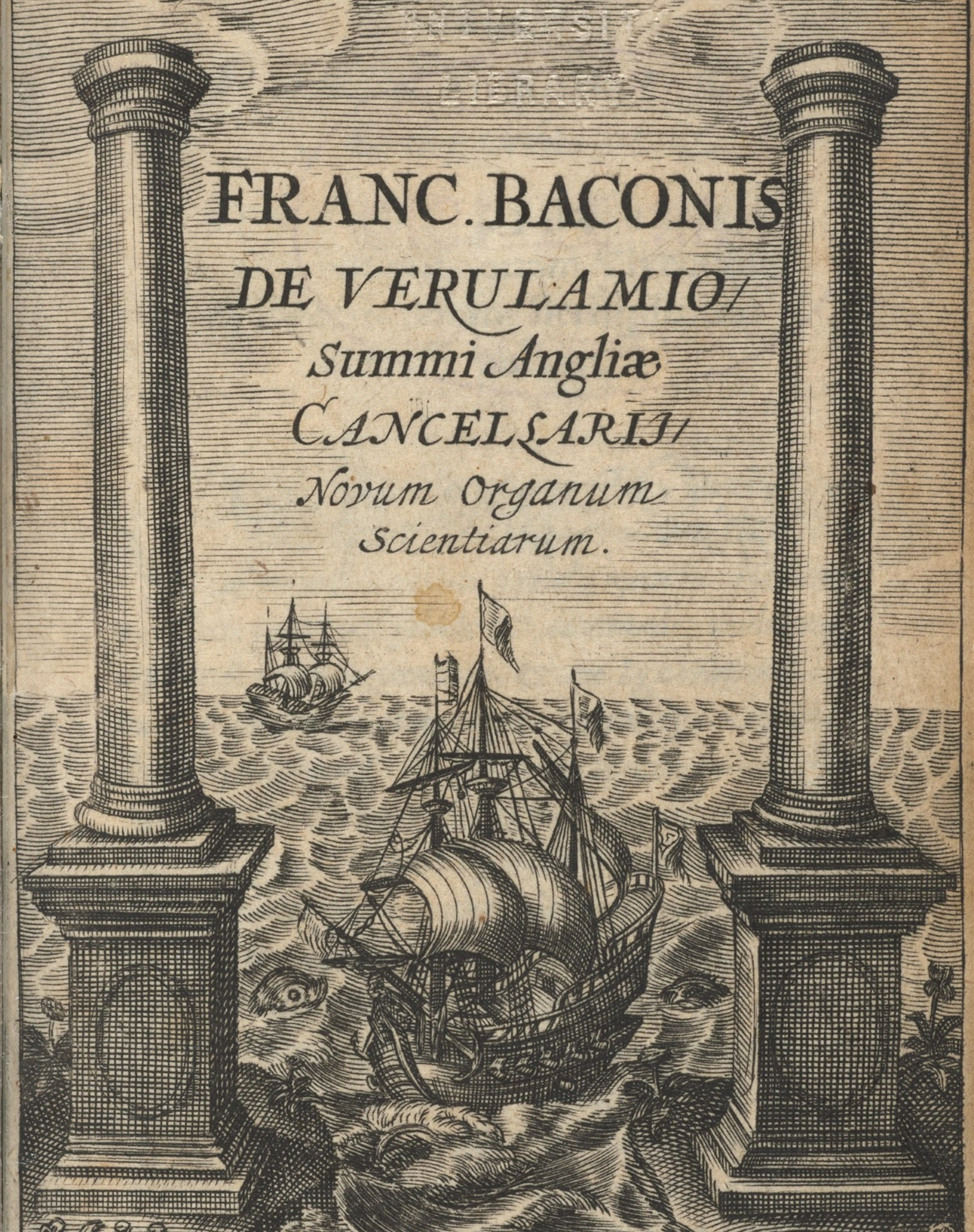
On the precise quatercentenary of Bacon’s death, 9th April, three men and a woman were completing their return to earth after boldly going further than any other humans in history. Bacon would have approved of Artemis II: after all, the frontispiece of Novum Organum[2] depicts a ship sailing through the straits of Gibraltar, leaving behind the classical lands of the Mediterranean and heading out onto the oceans of discovery towards the New World. That is what Bacon knew he was doing intellectually, fostering technical innovation in which England might pioneer. Such developments have, for example, doubtless assisted the better treatment of mental and bodily ailments as experienced by King Saul and by the two women in today’s Bible readings.
There are many more discoveries to be made on the high seas of scientific research. But not at any cost. As the Pope has recently argued in his encyclical on Artificial Intelligence, such developments need to be undertaken within a publicly agreed ethical framework if we are to avoid a repetition of the mistakes of unrestricted industrialisation and expansionist imperialism.
As a man of faith, Bacon sought a society shaped by the guardrails of Christian morality. This is not to say that he lived a life without flaw or taint. He was deeply enmeshed in the political intrigues of his day. Contemporaries saw him as arrogant, extravagant and pompous. As a judge, he delivered the death sentence on Sir Walter Raleigh. But he did not advocate an amoral world of unfettered experimentation and growth. So, as we recall the unique contribution of Francis Bacon to human innovation, we remember also a man of faith, an advocate of our very contemporary need for discovery within moral guardrails.
[1] Sprat ‘History of the Royal Society’.
[2] Including the first edition.