


The dead end of the year
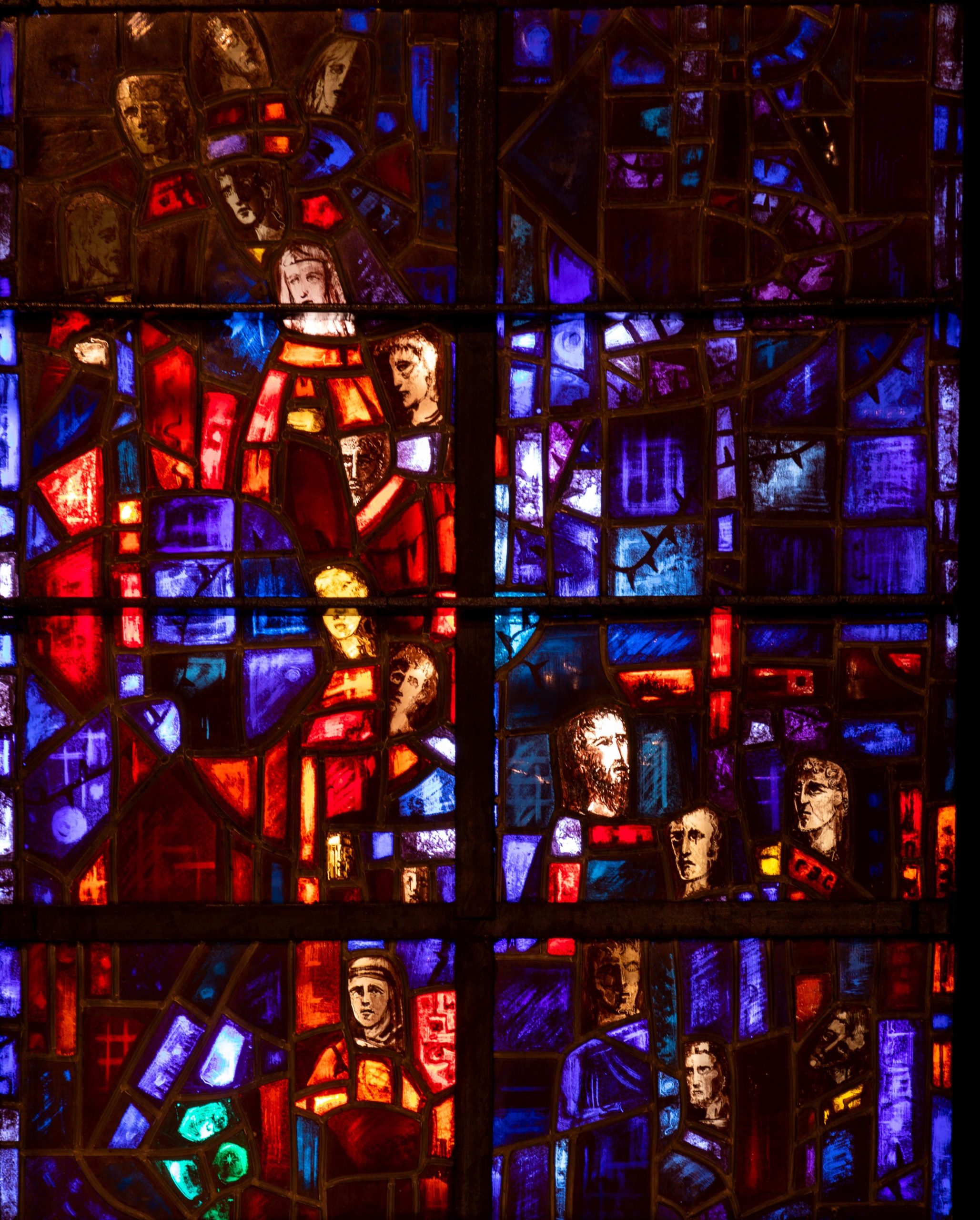
‘The dead end of the year‘
A sermon by Kenneth Padley for All Saints Sunday
Sunday 2 November 2025
Readings: Ephesians 1.11-end; Luke 6.20-31
Friends, we have reached a dead end.
We have reached the dead end of the Christian year. In a few weeks’ time we will be plunged once more into the mysteries of Advent and preparations for Christmas. However, before then, during November we watch as the embers of the old calendar flicker and fade.
Given this, it is apposite to reflect at this time on those who have gone before us in faith and fear. A celebration of all the saints became established in the western Church in the seventh century when the Pantheon in Rome was converted to Christian use. This magnificent circular building, once used as a pagan temple for all the gods (‘pan-theon’), was re-dedicated by the Pope in 609 as a church to St Mary and the martyrs. That act of rededication took place in the month of May, but collective celebrations of the saints were transferred a century later to the symbolically more appropriate November 1st. After all, we are at the dead end of the Christian year.
Now, not only does today’s festival fall at the dead end of the year: the ideas which we associate with people of holiness are located towards the end of systematic theology. What theologians say about the saints is predicated on logically prior ideas about the nature of the Christian gospel – especially the process of salvation. This is important because theological diversity has led western Christianity to generate two alternative models of sainthood, each deduced from prior theological arguments. I’d like to recap these models so that we can appreciate their similarities and distinctiveness, their pastoral implications, and what they might reveal about the role of sanctity in the world today.
It is widely known that, within the Roman Catholic tradition, saints are formally declared by the Pope after a complex and rigorous process of discernment and testing. Recent canonisations in Rome have included the millennial teenager and internet evangelist Carlo Acutis; Ignatius Maloyan, a victim of the Armenian genocide; and Bartolo Longo, a satanist who became a Christian.
Lying behind the Roman Catholic canonisation system is a belief that there are two categories of the Christian dead: the Church Triumphant in heaven and the Church Expectant in purgatory, a realm where souls are purified before being received into God’s nearer presence. Now, within this system, only those who have passed through purgatory and into heaven are eligible to be declared saints. In order to prove that someone has completed the transition, evidence is sought that a candidate has twice successfully interceded with God to bring about miracles on earth. Underpinning this is the assumption that those in heaven can hear or sense the prayers of the faithful on earth and, flowing from this, is the tradition that saints are ‘patrons’ of particular needs, groups or causes.
Now the Church of England, since affirming its institutional independence five hundred years ago, has never created an equivalent to the Roman Dicastery for the Causes of Saints, a body to discern whether someone has made it into heaven. This is because the Church of England was shaped at the Reformation by a theological framework which included a different articulation of sainthood.
The sixteenth century reformers could not find evidence in the Bible for purgatory. As a result, they concluded that there are not two categories of the Christian dead, only one. This aligned with their emphasis on the importance of God’s grace in the process of salvation, arguing that nobody can reach heaven through good works but that God in Jesus bridges the gap, and that people accept Christ’s invitation to be saved through faith. In Reformed thought, this gives rise to a single category of the redeemed, a category which includes both the living and the departed. The upshot of this model is that all Christians are saints: the person on the seat next to you just as much as the big names of the past; this congregation onsite just as much as our brothers and sisters online; Christians in Britain just as much as our counterparts around the world, including in different denominations and traditions.
Within the Reformed model, the role of the saints thus becomes less a matter of intercession and more one of example and encouragement. The saints embody and reveal lives of godliness for others to follow. Given this, the Church of England calendar includes days to honour the witness of those whose lives are worthy of public commemoration alongside those formally prefixed as ‘saint’. Two examples are the First World War nurse Edith Cavell and the prison reformer Elizabeth Fry, untitled saints who, by coincidence, share a festival on October 12th with the newly canonised Carlo Acuti.
Neither model of sainthood is without its challenges. I have already listed something of the Reformed critique of the medieval ideas against which they reacted. Yet the model of the Reformed, sainthood of all believers, is imperiled by complacency. If I am reckoned a saint through faith, then there is a risk that I will rest on my laurels or even wallow in sinfulness. The reformers of course did not intend this, arguing that all Christians pursue a path of sanctification – becoming more like Jesus – but this means that part of the daily task of Christian living is to guard against torpor and backsliding.
Whichever model of sainthood has shaped your thinking, it is helpful to be aware of both – not least because they can become amalgamated in the crucible of popular imagination with one another and with non-Christian ideas. Saints feel particularly vulnerable to cultural relativism because people look to them when they are at a dead end, times of trauma and bereavement when they are desperately looking for comfort, explanation and hope.
Whichever model of sainthood has shaped your thinking, I encourage you to return to scripture for fresh inspiration about saintliness. Here we are pulled up short by the startling oddity of exceptional Christian men and women. Saints in the New Testament are ‘agioi’, the word from which we get hagiography, lives of the saints. Agios means separate, distinct, set apart by God’s otherness for God’s holy purposes.
The world is much troubled by religious oddballs. As a result, our secular friends prefer religion to be ‘moderate’. However, saints – as people distinct and set apart by God’s otherness – indicate that things might be radically different – and indeed one day will be radically different. There is nothing moderate about loving God with all our heart and soul and mind and strength. There is nothing moderate about Jesus’ vision for society in today’s gospel. There is nothing moderate about prophetic figures like Francis of Assisi or Mother Teresa.
New Testament professor Richard Bauckham says that
Sanctity is extreme… We should not be seduced by the secular desire to keep religion within comfortable bounds… The truth of God in Jesus Christ demands wholehearted commitment to the way of Jesus, a truth that cannot be supported by violence, a truth that violent enforcement can only contradict. That truth may prove unsettling for secular society, for it certainly cannot leave society to go its own way unchallenged. But its power to disturb is part and parcel of its intrinsic power to convince.[1]
The power of Jesus Christ to disturb is part and parcel of his power to convince. The oddity and difference of holy people point to that and – as saints – we are incorporated in the same task. Amen.
[1] Bauckham, Richard. The Bible in the Contemporary World, (London: SPCK, 2016),170.