


The City of God
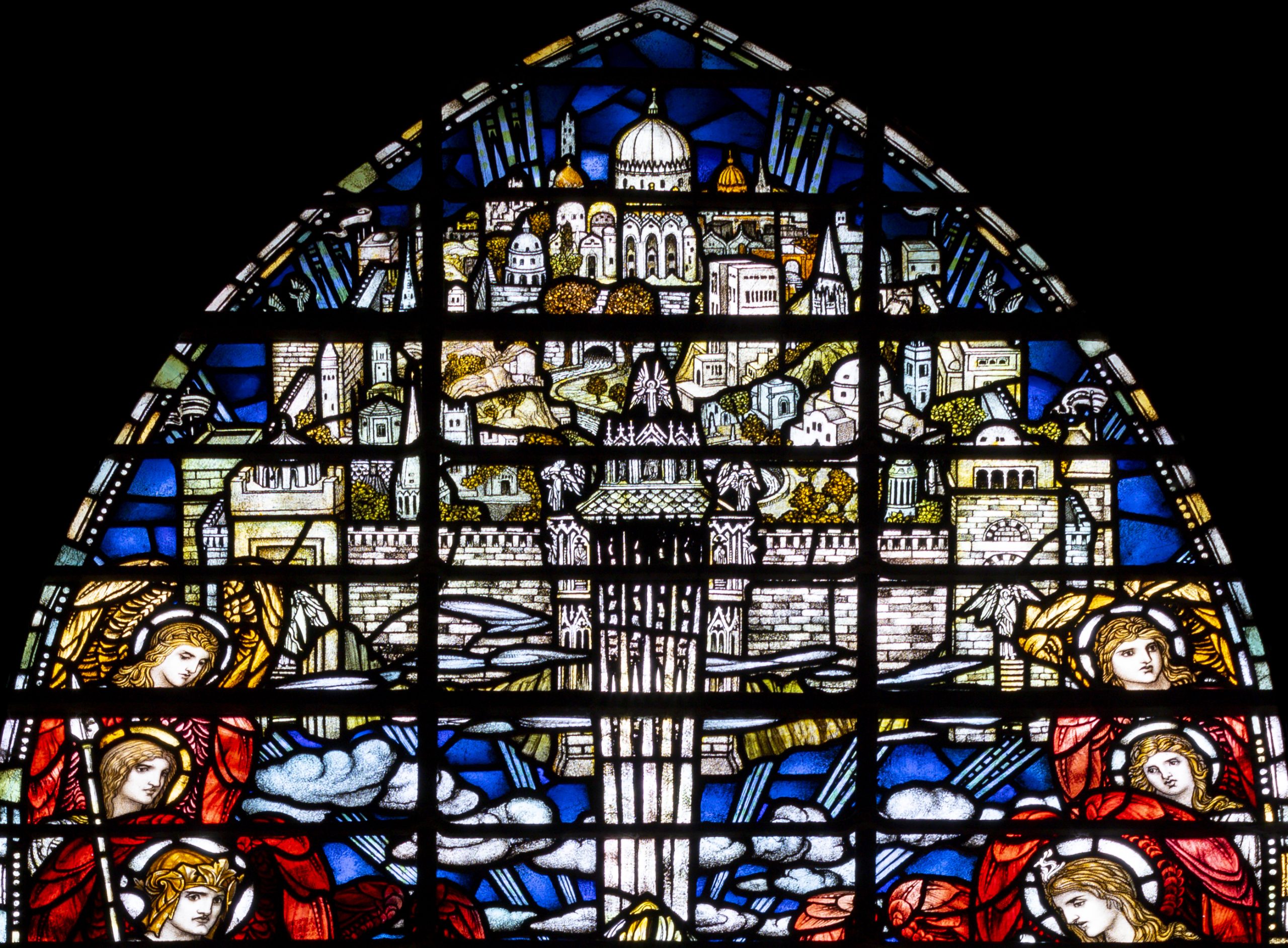
‘The City of God’
Sunday 3 May 2026
A sermon for the Fifth Sunday of Easter by Kenneth Padley
Revelation 21.1-14
Martin’s Scorsese’s 2002 movie Gangs of New York depicts gratuitous blood-letting between Protestants and Catholics in the late nineteenth-century American metropolis. The message of the film is that violence begets violence – and that religion acts as an accelerant. The movie ends with a ray of hope as the graves of the chief protagonists decay away against a backdrop of New York appearing to ‘grow up’ through successive development of the city’s built environment. The implication is that things have moved on and that we are being offered a tale of two cities, a flawed religious past and a progressive secular present.
However, in a twist of irony, the very last shot of Gangs of New York portrays the World Trade Centre standing proud against the skyline. This film was recorded prior to 9/11 but released afterwards. If that final scene had been planned as an assertion of optimistic progress, the conscious decision to retain it in the public release of the film is proof of the opposite.
Given that humanity seems trapped in such a doom loop of renewal and failure, what are we to make of the perfect Jerusalem envisaged by Saint John in today’s reading from the Book Revelation? It is not as if Saint John was detached from reality. He was a member of a minority faith community subject to bouts of persecution by the authorities. Indeed, John wrote Revelation in cryptic code-language as a protest against the oppressive forces of Roman imperialism. Particularly informing the background of his thought was the catastrophe of 70AD when the Romans had razed Jerusalem to the ground after a massive siege. Having seen what he had seen, how could John possibly believe in that radiant vision of a city in which ‘death will be no more; mourning and crying and pain will be no more’?!
I’d like to suggest that John imagined the new Jerusalem because he was part of an Easter community, part of a Church which experienced radical otherness in the resurrection of Jesus. If God can raise one person from the dead, might he not also shatter the wheel of brokenness which characterises earthly existence?
I’d like also to suggest that John imagined something as amazing as the new Jerusalem because he was part of a Christmas community, part of a Church which celebrated the truth that God took flesh in Jesus. If matter matters to God not only to create it but also to become incarnated within it, might not material things also be part of his ultimate plan for the future?
When Saint John’s community celebrated the birth of Jesus they sang the words which we now know as the Christmas gospel, John 1.14, ‘the Word became flesh and dwelt among us’. ‘Dwelling’ in this clause literally connotes living in tents. The original Greek of this verse uses a specific verb which recalls the experience of God’s people in the wilderness, when God’s presence was thought to inhabit their sacred tabernacle, the tent of meeting.
The author of Revelation uses that same, very specific word to describe the divine presence within the new Jerusalem. Revelation 21 verse 3,
See the tabernacle of God is among mortals.
He will tent with them
They will be his peoples
And God himself will be with them.
Now the author of Revelation was not a slavish repeater of tradition. Through the Holy Spirit he had been gifted a visionary creative imagination. And so he did not speak of God’s inhabitation of the end times as localised, like in the earthly tabernacle. We know this because of the striking dimensions that he records of the holy city. Immediately after today’s text we are told that New Jerusalem will be as wide as it is long. Now a square makes good sense in terms of urban planning. But then John insists that city will be as high as it is wide – a cube. That is much more problematic. St John was not setting a challenge to civil engineers nor our imaginations. He was alluding to the Holy of Holies – the inner sanctum of the tent in the wilderness and the later Temple in Jerusalem which was shaped like a cube.
The Holy of Holies in the Temple was destroyed by the Romans in 70AD. But because John knew the truth of Christmas, he was not downcast. He knew that if God could tent in the person of Jesus, then God could also build a perfect city where his presence is not locked in a secretive room in a building for the elite but would become a reality for everyone because it pervades the whole city.
Alas, such perfection seems a long way off. So what are we going to do here and now with the frustration of broken communities? To attempt an answer to that question we need to travel to one more city. Back in the year AD410, the imperial capital Rome was overrun by Goths – that is Germanic invaders, not grungy teenagers. The events of AD410 threw the foundation myth of this greatest conurbation on earth into a tailspin: the self-proclaimed ‘eternal’ city had fallen.
The defeat of Rome posed a particular propaganda problem for imperial Christians. Since the conversion to their faith of the Emperor Constantine a hundred years earlier, Christians had promoted the cosy assumption that a close union of Church and State would ensure mutual prosperity. However, in AD410, despite fervent prayers to the city’s patrons, saints Peter and Paul, Rome had been conquered. And not only were the invaders foreigners, worse still they were Arian, Christian heretics who didn’t believe that Jesus is God. Why on earth would the Almighty allow such a thing to happen?! Traditional aristocratic pagans suggested that the problem might in fact be Jesus and wouldn’t it be better if everyone got back to sacrificing to the city’s former deities? It was a challenge that invited – necessitated even – a robust Christian response.
Into this void of fear and doubt, the greatest writer of the early Church wrote the greatest apology of the age. It took 13 years to complete. The man was a Bishop from North Africa, Augustine of Hippo. And his book is called the City of God.
At its heart, Augustine’s City of God is an exploration of the problem of evil. It is an enquiry into why life on earth is characterised by cyclical patterns of rise and fall. Augustine’s response is to argue that evil is not an active force but a privation, an absence of goodness. And he concluded that this privation is found in every realm on earth. The world, Augustine insisted, is a mixed society of vice and virtue. This entanglement permeates even the Church: Augustine could not accept a naïve division between those who claimed allegiance to Jesus on the one hand versus everyone else on the other. Augustine understood all society to be characterised by a commingling of good and evil. And he likened this division to Babylon and Jerusalem, an earthly ‘city’ (inverted commas) which glories in itself and a heavenly ‘city’ which glories in the Lord. These two cities live alongside one another until that day when God ushers in his new and perfect Jerusalem.
Augustine’s City of God is a healthy antidote to unrealistic optimism in the human capacity for progress. It turned the critique of the pagans because it explained why even an ostensibly Christian Rome might have fallen. And it asserts that we must still strive for the best on earth while simultaneously lifting our horizons through faith to that new and perfect city which is to come, Jerusalem the Golden, that end time realm where the God of Christmas and Easter will dwell fully with all his people.