


Peregrine Blog No 1 2025
How time flies; it seems like no time at all since July 2024 when I sat down at the keyboard to write the third and final blog of 2024. And yet here we are at the start of what we hope will be another exciting and successful new season with our resident Peregrines.
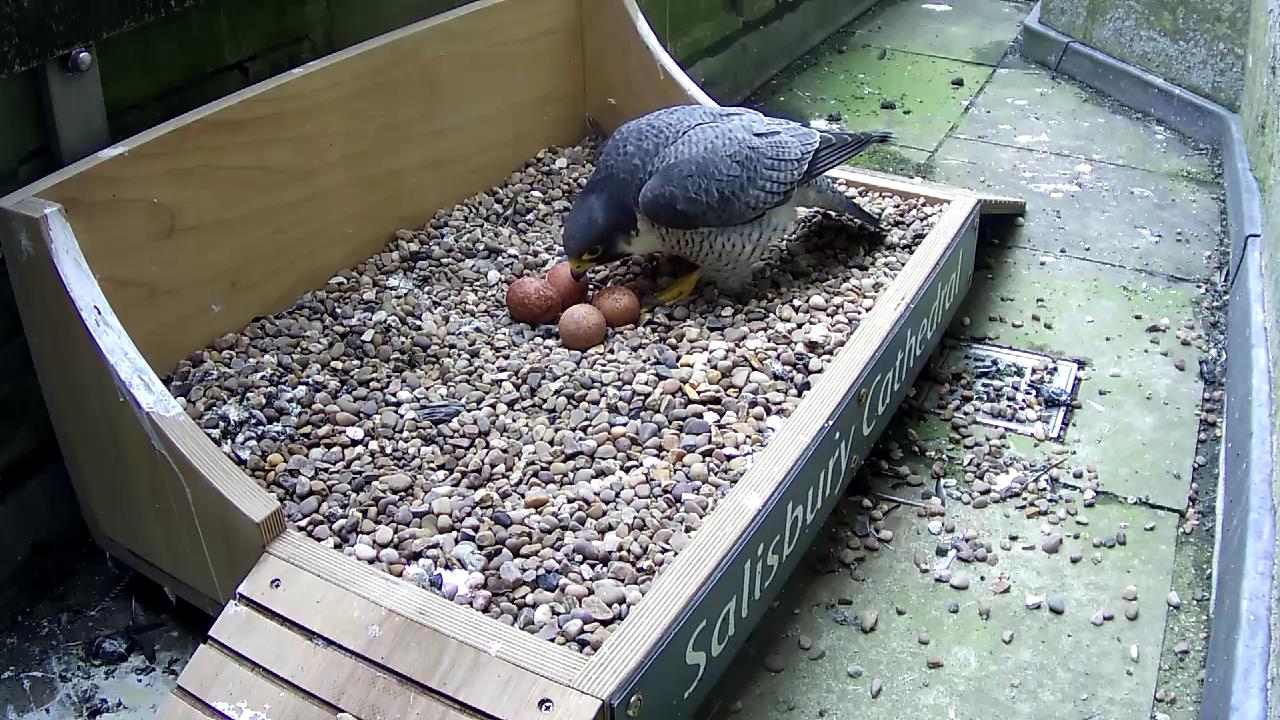
The first thing that regular viewers of the Cathedral nest cam will have noticed is that we have a new nest box for 2025. This is, if memory serves, the third nest box which the cathedral carpenters have made for the birds. All have been made out of very solid wooden materials, but inevitably given their exposed position to the weather and the fact the that gravel substrate in the box probably keeps the inside faces damp for quite long periods of time, some degree of deterioration is inevitable. Human incompetence doesn’t help either. Viewers of the nest cam will not be able to see it as it is hidden beneath the nest box, but there is a small circular drainage hole at the base of the parapet wall designed to help drain the walkway. This is in addition to the visible metal grill in front of the box. Regular readers of this blog will know that we are always concerned about prey remains and general debris blocking the drainage on the walkway and possibly causing problems for the chicks, especially if they leave the nest box at an early age and end up in standing water. Some years ago, at the end of the season regular clear up of the walkway, I pulled back the extremely heavy first nest box to get at this hidden drain hole to clear it, when the side of the nest box came away in my hand……..it was an accident guv; honest!!!
This is the third design of nest box to be used, and the immediate stand out feature is that it has ‘ramps’ at either end of the box; nest cam enthusiasts may have seen a similar system in past years at the nearby Winchester cathedral Peregrine site. There has always been a danger of chicks, especially when they are still in white downy plumage, of rather prematurely leaving the safety of the nest box either deliberately or by accident. If there is no way of getting back into the box, especially in wet weather, there has always been the danger that a chick might perish. Whether the parents would feed a very young chick out of the box whilst the others are all still in it is something we do not know; we would hope so but we cannot be certain. In past years we have solved this problem by placing a couple of house bricks beside the box and hoping that any stray chick works out how to use the bricks to get back into the box. It has sometimes been rather painful watching the attempts of chicks to regain the safety of the nest box via the bricks, but to date all have finally worked out how it is done, much to the relief of all involved. With the new ramp system, these ‘heart in the mouth’ incidents should be a thing of the past. It is not just the chicks who will hopefully use the ramps; our resident male has already been observed gaining access to the nest box by walking up the ramp.
Not only do we have a new nest box for 2025, but the nest cam has been ‘live’ and available to view from much earlier in the season. This has enabled us to see the early stages of courtship between our resident pair and also the way in which the nest scrape has been created in the pea gravel nest substrate. The camera went live towards the end of January and it has been possible to see the usual Peregrine courtship display whereby both adults face each other in the nest box and bow vigorously to each other whilst at the same time calling very noisily. The creation of the nest scrape is also very interesting with the adult male laying on his chest in the box and pushing out substate backwards with his legs. It looks rather incongruous but it seems to do the job.
As in recent years, both our adult male and female are unringed, so we have no reliable way of telling if they are the same pair which occupied the site in 2024 or indeed further back in time. Adult Peregrines (other than between sexes) are remarkably similar in plumage, so telling whether we have had a change of one or both birds is very difficult indeed; study of sharp still photographs of the birds from this and previous years might shed some light on this; we shall see. What we do know, is from when the birds first returned to the cathedral to lay eggs in 2013 to the current time, we have never had a colour or metal ringed bird in resident at our site other than Sally, a resident female at the site, who was actually captured at the nest box some years ago and ringed. This absence of ringed birds is on the face of it quite surprising, as nest cams at nest boxes are located on a large number of other urban made structures in the UK , and frequently reveal the presence of ringed birds from other sites. In addition, we do seem to have a relatively small number of ‘intruding’ birds at the cathedral site whereas other sites in 2025 have already reported a number of such ‘intruders’, including visitations from birds fledged from the same site in the previous year. These fledged birds from the previous year have in the past been seen to help out with the rearing of the chicks from the current year, but on other occasions have proved to be quite a disruptive influence.
The first egg this year was laid on 16 March, a fairly typical date for our site; in 2024 it was on 21 March and in 2023 it was on 17 March. As I type this blog we have a clutch of four eggs, the last one having been laid on 21 March. The earliest egg laid elsewhere that I have heard about in 2025 was a first egg in Fulham on 2 March. Four eggs tends to be a typical clutch size for Peregrines, clutches of three are not uncommon and there are occasional clutches of five and the very occasional one of six. With our nest cam being watched by a very large number of keen observers, RSPB South Wilts group reports that after the first egg, the second, third and fourth eggs were laid at 61, 59 and 60.5 hour intervals; an amazingly consistent time span between egg laying.
If four eggs is to be our full clutch in 2025, then assuming that incubation starts after the laying of the third or fourth egg, and incubation takes typically about 32 days, we can expect that hatching will begin sometime around 23 April. With fledging occurring about six to seven weeks after the eggs hatch, we can expect the chicks to first take to the wing in the second week of June.
In past years, the South Wilts RSPB group, in conjunction with the Cathedral, have organised a ‘Date with Nature’ event at the west elevation of the cathedral so that visitors can view the adults and their chicks through telescopes. Assuming all goes well it is intended that this event will again take place this year for about three weeks after the date of fledging. So make a note in your diary and come and join us; I promise you will not be disappointed.
Granville Pictor 24 March 2025.