


Peregrine Blog 2 2026
Well, true to form, my crystal ball once again did not fail me. I anticipated in Blog No 1 2026, that four eggs would likely be the full clutch in 2026, and so it turned out to be. I also predicted that the first egg would hatch ‘at the end of April or the first few days of May’. In truth, given the margin of error in that statement, it could hardly fail to be correct, could it? That said, the actual hatching dates were as follows.
Egg No 1; 16.42 on Saturday 2 May.
Egg No 2; 07.40 on Sunday 3 May.
Egg No 3; 10.50 on Sunday 3 May.
Egg No 4; 12.30 on Tuesday 5 May.
Sue Walker from the South Wilts RSPB Group, who has a very good knowledge of Peregrines, sent me an email on 30 April and predicted, based on data of the date of first egg and times of incubation from the years 2020 to 2025, that the first egg should hatch on 2 May. As you can see, she got it spot on; take a bow, Sue.
We have been amazingly lucky with the weather this year (unless you are a gardener or farmer), as from hatching to the current time, we have had very little rain or cold weather. Both rain and cold weather, especially when combined, can be particularly difficult for young chicks when they are in their early white down phase. Whilst their parents, particularly the female, will seek to cover them to protect them from the elements, this is not always successful; indeed, in 2016 if memory serves, two small chicks at the cathedral succumbed in the bad weather in that year. By contrast, 2026 has seen very dry conditions and unusually high temperatures, particularly toward the end of May. Regular viewers of the nest cam will certainly have seen, particularly in the last week of May, the chicks panting in the hot weather and seeking shade during the sunniest and hottest parts of the day. This is where the two ramps attached to the nest box, an innovation designed into our latest nestbox (our third), have proved so successful. This has enabled the chicks to easily leave the nestbox at quite an early stage of their development, and as soon as they are fairly mobile, to seek out the coolest spots outside of the nestbox. It also enables them to climb back into the nestbox if they wish. That said, in reality, it seems, having left the box, they mostly seem happy to spend most of their time, including at night, out of the box and on the stone walkway.
As in past years, the diet of the chicks has been quite varied. From what I have seen whilst watching the live feed, when they were very small, mostly small prey items were brought in, almost always by the adult male. These are often part-plucked and vary hard to identify at the species level, although I dare say more avid watchers of the live feed may have seen some items which were identifiable at the species level. An examination on site of the prey remains when we ringed the chicks on 28 May suggests that in recent days at least, the chicks were mostly fed on Pigeons and corvids (probably Jackdaw) and Starlings. I do also recall seeing what looked like the remains of a Black-Headed Gull a few weeks back. As in past years, most of the feeding of the chicks is done by the adult female, but sometimes the adult male lends a hand, and on one occasion when I was watching the live feed some days ago, both adults were feeding the chicks at the same time; quite a sight.
This amount of detailed behaviour at the nest has really only been possible in relatively recent years because of the introduction of nest cams such as we have at the Cathedral; and their quality has in itself advanced dramatically in recent years. You only have to think back to the images we had at the Cathedral when net cams were first employed and compare them to today’s images. The original cameras were good, but the quality, to my eye at least, has taken a quantum leap forward in the last few years. Before nest cams and the relatively recent urban nesting habits of Peregrines, all enthusiasts could normally do was to observe Peregrine nests at long range on inland crags or sea cliffs via a telescope…Ah, I remember those days well. I often wonder, on a slightly sentimental note, how sad it was that the late Derek Ratcliffe, who died in 2005, never lived to see the advent of nest cams. He was arguably, in the UK at least, the most outstanding field biologist and conservationist of the 20th century. He was Chief Scientist of the then Nature Conservancy Council for several years until his retirement and was an outstanding botanist, expert on mosses and ferns and many more things. He is of course, best remembered for his work on Peregrine Falcons and his monograph on the species, first published in 1980, was aptly entitled ‘The Peregrine Falcon’. It was quite beautifully written and opened up a whole new world on the species, including its breeding habits, distribution and hunting strategy. I bought a copy when it first came out, and if I was not ‘hooked’ on the species before then, I certainly was after I read it.
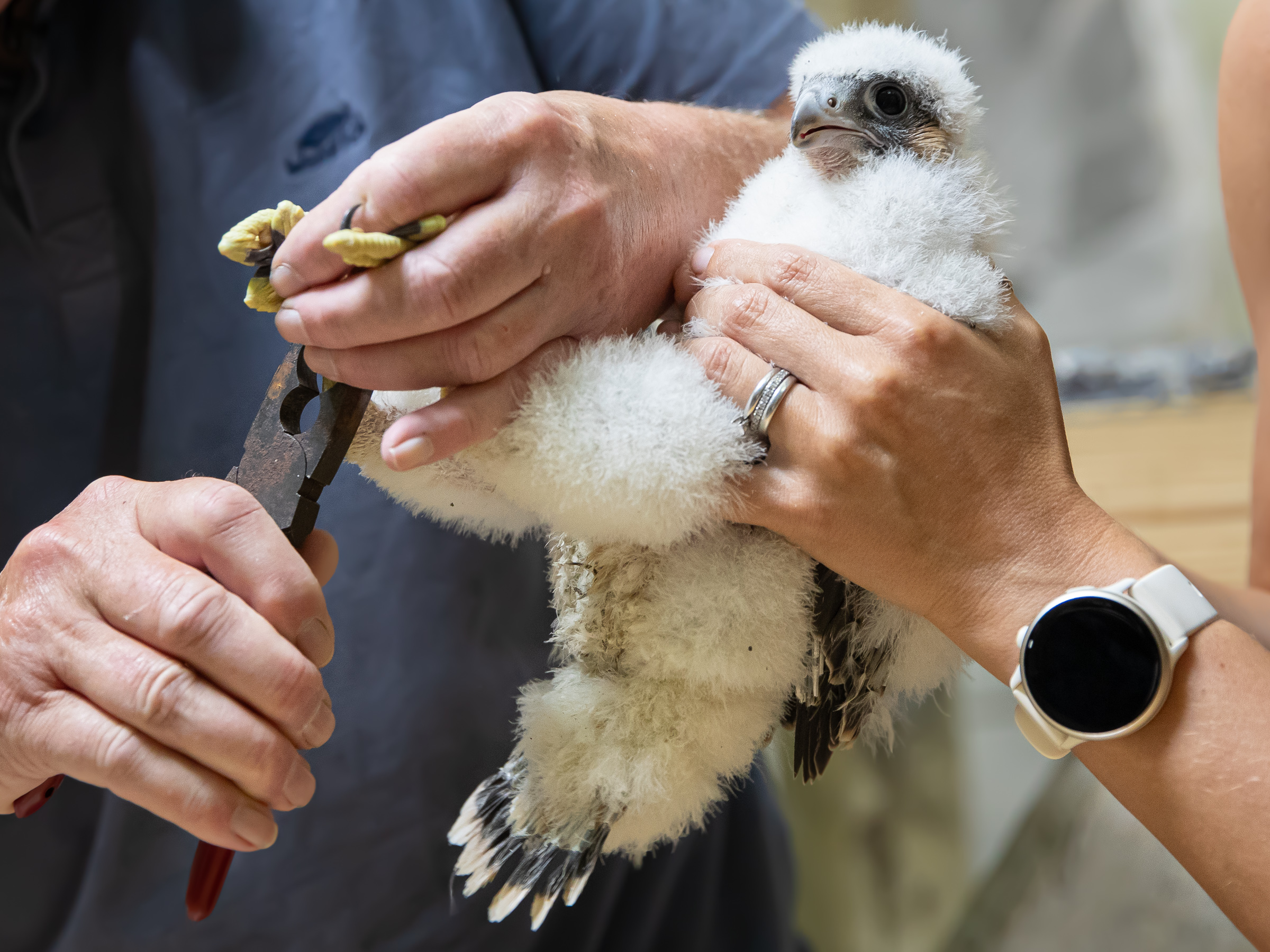
Moving swiftly on to the current time, on 28 May the chicks were ringed. I am not quite sure why, but my job, every year since 2014 when we first ringed the chicks, is to go outside whilst the chicks are being ringed in the cathedral tower, and sweep up all of the prey remains from around the nest box and the walkway area, and also ensure that the metal drain beside the nest box is clear to avoid possible flooding. Viewers of the nest cam hopefully will have noticed this transformation of the nest area after the ringing! In some years, including this, Gary Price, the Clerk of the Works at the Cathedral, has helped out to speed the process along. The adult falcons always fly around calling whilst the clearing up is going on and the chicks are being ringed within the tower. I am not quite sure why, but this year, unlike past years, the adult female was particularly aggressive and on several occasions swooped at both Gary and me at high speed and came certainly within a metre of our heads if not closer. Quite why the adult female was so aggressive this year, assuming as seems likely it is the same bird as in recent years, it is hard to say; it was certainly interesting nonetheless. Ringing is always carried out as quickly as possible, and as soon as the chicks are returned to the nest area, the protests from the adults subside and normality returns.
With regard to this year’s chicks, their ringing details are as follows;
Orange colour ring 3VJ; female; 970 grams.
Orange colour ring 3SJ; female 1000 grams.
Orange colour ring 3XJ; male 660 grams.
Orange colour ring 36J; male 700 grams.
The chicks must be very well fed, as a female chick at a little less than four weeks old at 1000 grams is certainly big for its age. Male chicks, as with the adults, are always substantially lighter than females, and this can be seen from the above details. Assuming all goes well, the chicks should fledge in about three weeks, so probably in about mid June.
As in previous years, each of the chicks will be named, and the names this year will be based around the cathedral’s year-long theme of ‘Joyful Noise’. Submissions from the public for names close on 5 June; further details can be found here.
Also as in previous years, the South Wilts RSPB Group in conjunction with the Cathedral, will be running its usual ‘Date with Nature’ event at the west front of the Cathedral. This will run from 11.00am to 4.00pm Mondays to Saturdays, from Monday 15 June to Friday 10 July. This is always a great event where visitors can view the Peregrines, both adults and fledged chicks, through telescopes. It is an event not to be missed so I hope to see some of you there.
Granville Pictor 29 May 2026.