


Salisbury Cathedral completes two-year conservation of impressive ‘Angels’ stained-glass window
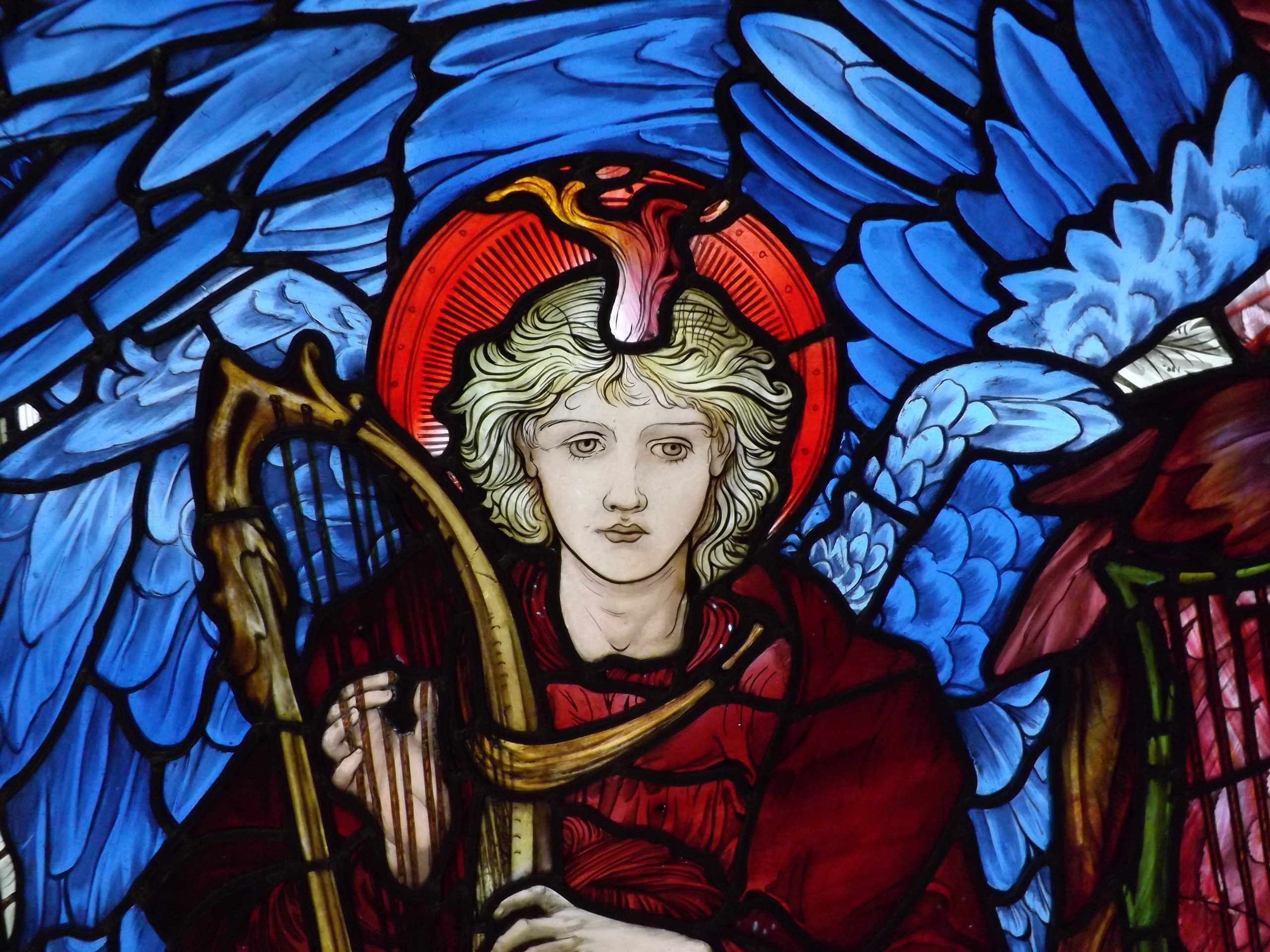
Salisbury Cathedral completes two-year conservation of impressive ‘Angels’ stained-glass window by Pre-Raphaelite artists William Morris and Edward Burne-Jones
The glazing team at Salisbury Cathedral has completed a two-year conservation of one of the Cathedral’s most significant artworks, a stained-glass window designed by leading Pre-Raphaelite artists William Morris and Edward Burne-Jones.
The 6.5-metre-high window was removed in February 2024 for inspection and conservation in the Cathedral’s glazing workshop. It was recently returned to its place above the south Quire Aisle in the Cathedral and will be re-dedicated at a special Evensong service on 7 May.
Over more than 150 years, water ingress, condensation and the deterioration of much of the painted detail (due to poor firing when originally made), had led to the need for urgent restoration.
Known as the ‘Angels’ window, it was commissioned as a memorial to Captain George Townsend by his sister Barbara, an artist who lived at Mompesson House in the Cathedral Close. Barbara was a friend of William Morris, whose company, Morris & Co, made the window in 1879.
The two lancets depict ‘Angeli Ministrantes’ and ‘Angeli Laudantes’, or ‘Ministering and Praising Angels’. Similar designs have also appeared on tapestries, other artworks and even greeting cards, demonstrating the versatility of Burne-Jones’ work. William Morris designed the Acanthus leaf foliage motif as a surround and the window was most likely painted at Morris & Co’s Merton Abbey Works in South London, before being transported to Salisbury.
The window is of great historical and artistic significance as a fine example of the large-scale work of the two artists. Edward Burne-Jones (1833-1898) was one of the last Pre-Raphaelites, looking for inspiration from medieval art, religion, myths and legends, and working across painting, embroidery and jewellery, as well as stained-glass.
William Morris (1834-1896) was a major contributor to the revival of traditional British textile arts and methods of production. Inspired by nature, he designed some of the most recognisable textile patterns of the 19th century, including Strawberry Thief, Trellis and Willow Bough. With his friend Burne-Jones, he was a pioneer of the Arts and Crafts movement, which aimed to bring beautiful design to everyone.
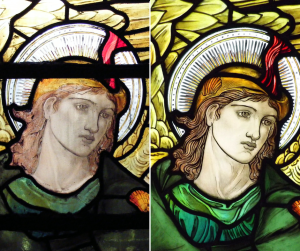
This ambitious project has been undertaken by Salisbury Cathedral’s skilled glazing department, based onsite alongside the Cathedral. Comprising experts in stained glass conservation, the team undertakes a range of work, including the conservation of medieval to contemporary stained glass.
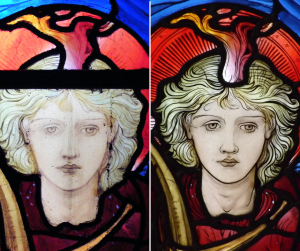
Conserving the ‘Angels’ window has involved a meticulous process. First, once in the workshop, a detailed cleaning and documentation phase captured its true condition. Temporary measures addressed water ingress for stability during restoration and careful lead work prevented further deterioration.
Original chalk drawings were used for reference, to guide the delicate enhancement of missing painted details. Thick iron bars have been replaced, to better display the designs, and protective glazing and oak frames now shield the window against future deterioration.
Leading the project has been Head Glazier Sam Kelly, whose depth of knowledge about the Cathedral’s glasswork stems from an apprenticeship at the Cathedral and refining his craft over forty years. Sam has an accreditation from The Institute of Conservation (ICON) and is an associate member of the British Society of Master Glass Painters. He plays a crucial role in overseeing the care and conservation of all the Cathedral’s stained-glass windows. Working alongside Sam on this project have been his colleagues Vicky Pearce (ICON technician), Kate Kersey and Alfie Durrant.
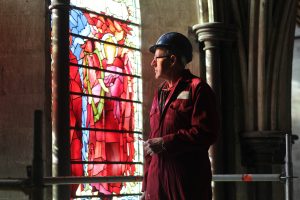
Sam Kelly, Salisbury Cathedral’s Head Glazier, said:
“This has been a challenging project for all of us, but one that has given us the opportunity of being up close and personal with this very special work of art, allowing us to gain an insight into how the Morris studios worked and some of the problems that they experienced.
“We have learned a lot about the history and execution of this window during the conservation process. It is pleasing to know that the work we have carried out will now allow the window to be enjoyed by generations to come.”
The Very Revd Nicholas Papadopulos, Dean of Salisbury, said:
“The Cathedral team have restored the contours, clarity and colour of this nineteenth-century masterpiece through their painstaking work. We are very proud that the artistry of the William Morris studio has been preserved and enhanced with such conspicuous contemporary skill. Sunlight will illuminate Burne-Jones’s angels once more, and their rare beauty will lift our spirits and rekindle our hope for many more years.”
The conservation of this historic window cost almost £120,000 and has been generously supported by the Dulverton Trust, the Idlewild Trust, St Andrew’s Conservation Trust, The Arts Society Salisbury, the Benefact Trust, the Pilgrim Trust, the Society of Antiquaries of London, the Stuart Heath Charitable Settlement and many individual donors.
The window can be seen in the South Quire Aisle and will be rededicated at Evensong on Thursday 7 May at 5.30pm.