


Peregrine Blog No 2
Well, my crystal ball does not need replacing just yet!
I predicted in my first blog of 2025 that the first egg should hatch on around 23 April. True to form it hatched just past mid-day on that date, the second hatching on the same day, the third on 24 April and the fourth on 26 April. I did wonder if the fourth egg would actually hatch, but better late than never. This late hatching of the last egg has occurred several times at the cathedral in the past and probably accounts for one chick, at least in the first two or three weeks since hatching, being noticeably smaller than the others, probably also accentuated if it happens to be a male chick which almost always will be smaller than a female of the same age.
We have been blessed (unless you are a gardener) with lovely fine weather since hatching with only the faintest smattering of rain. This is perfect weather for newly hatched and developing chicks whilst they are in their white downy and non-waterproof plumage. Whilst in the first week or so an adult can gather all of the chicks under its wings to provide shelter from the rain, at just over three weeks old as I type this, they are far too big and in really heavy rain they can become wet and quickly chill. This chilling can sometimes prove fatal to chicks, and on exposed coastal cliffs for example, in really bad wet and windy weather, whole broods can perish. Some years ago, one of our cathedral chicks perished in such weather, but luckily the protection offered by the parapet wall and sunshade means that such cases here have been remarkably rare.
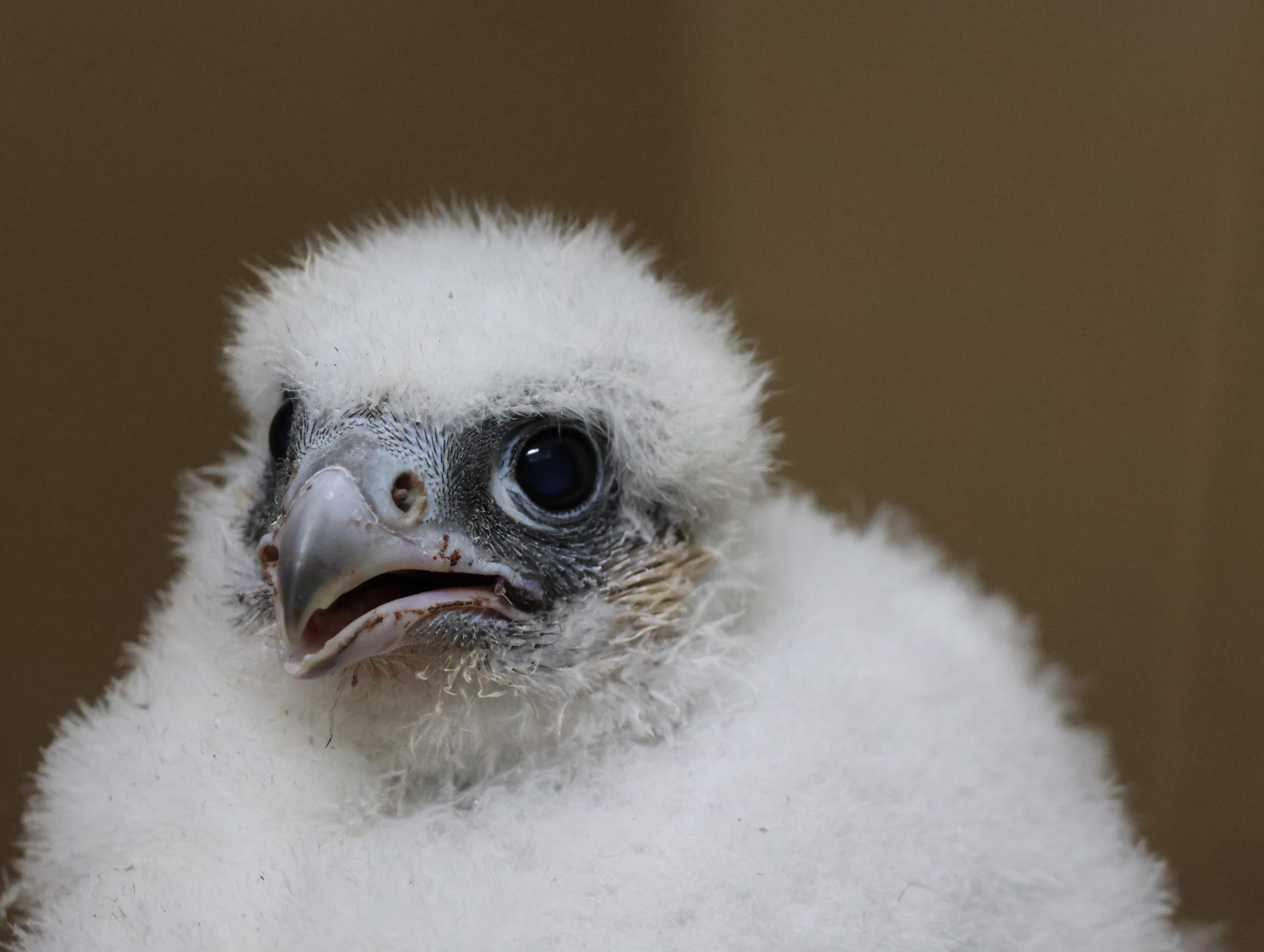
As is frequently commented upon by many of our webcam viewers, the chicks grow amazingly quickly from tiny balls of fluff at first hatching to quite large plump individuals at about three and a half weeks old; at which time I am typing this blog. I am not quite sure why, but at this stage they always remind me of little old men in old coats, probably reinforced by them shuffling around uncertainly on huge feet. At this stage they are becoming increasingly mobile and the two ramps either side of the nest box, a new feature for the first time in 2025 are clearly a great success. I have just watched all four chicks being fed in the nestbox by the adult female, and as each one has had enough food it has walked down the ramp off the nest box. In this instance the smallest chick which seemingly in this case could not push itself through its siblings to the front of the food queue was left on its own in the box, and was fed by the adult until it too had had its fill and also wandered down the ramp to join its siblings on the stone walkway. This behaviour of leaving the nest box at this age or thereabouts has been seen every year and in hot weather or indeed wet weather means the chicks can probably find more shade or shelter than if they remained in the box. It would be remiss of me not to comment somewhere within this blog on the really excellent quality of the live webcam images and audio feed which we enjoy with the equipment provided by the cathedral these days. Technology has really moved on a pace from the rather more grainy images which we first had from less sophisticated kit when the webcam first went live many years ago. The audio feed is particularly good, it is now so easy now to have the live feed minimized on your computer whilst doing other work, and just log into it when you hear a frenzy of activity from the chicks which probably means its feeding time; great stuff!
Speaking of feeding activity, as in past years, and as far as I can tell from having watched the live feed, in the very early days after hatching, food items seemed to be mostly small birds, brought in mostly already partially plucked and making it very hard to tell what species were being taken. As the chicks have grown older and require more food, the prey brought in has mostly increased in size and of late seems to have comprised mostly of pigeons, corvids; probably Jackdaws and Rooks. A number of Starlings have also been taken and the chicks seem to have no qualms about swallowing whole feet and legs in one go of birds of this size; you would think maybe they could choke on such awkward shaped bits of prey, but not a bit of it, everything is consumed with great gusto. Whilst the afore mentioned species are seemingly the most frequently taken prey items, when we went out onto the south face walkway to ring the chicks on14 May, I did have a quick look through feather remains in and around the nest box and was surprised to find heads of a Woodcock, Snipe and Teal. It is impossible to say if if these birds were caught recently or earlier in the year, but it does show what a wide variety of birds are taken by these birds. Neither Snipe or Teal have bred in Wiltshire in recent times, and the nearest Woodcock breeding woods are some miles away. It seems very likely therefore that these birds were migrants and very probably caught on their migration at night. There is a lot of evidence now that in city locations, Peregrines quite frequently hunt at night, their prey being illuminated somewhat from below by glowing city lights. The illumination of the spire at night at the cathedral would certainly help Peregrines see prey species flying overhead. I can recall visiting the cathedral in winter long before birds ever started breeding there, to watch single and sometimes seeming mated pairs coming to roost on the spire at night and illuminated by the spire lights. These birds circled the spire before finally roosing looking very pale, almost white, and amazingly obvious in the lights, not unlike enormous moths circling a light source. I suspect that this same illumination now enables the birds to hunt birds at night which pass quite close to the cathedral.
I mentioned above that the chicks were ringed on 14 May. The ringing went smoothly as ever; we have been lucky enough over the years to have been able to count on the services of a number of very experienced licenced ringers, all with considerable experience of ringing Peregrines. The details of the ringed chicks were;
Female; weight 890 grams, darvic colour ring 3ZJ.
Male; weight 610 grams, darvic colour ring 3NJ.
Male; weight 620 grams, darvic colour ring 33J.
Male weight 520 grams, darvic colour ring 3RJ.
As usual, the female chick was considerably bigger than the three males, a characteristic of course carried through to when the birds are adults. The small male is I suspect the chick from the last egg to hatch, but one can never of course be certain of this. As we did last year, a DNA sample was taken from each chick via a swab taken from within the beak. This is used to confirm for certain our provisional assessment of the sex of each bird and also provides a unique ‘ fingerprint’ so to speak of each bird. This DNA sampling is now a commonly carried out procedure when ringing Peregrines and a large database of information relating to chicks is now being compiled. Amongst other things, this database provides a very important tool for the investigation of any wildlife crime relating to the illegal taking or breeding of such birds. A claim that a bird bred in captivity which is viewed with suspicion would certainly be near impossible to substantiate if a sample of it’s DNA were shown to reveal it was from a brood of wild bred chicks ringed at a certain site and on a certain date.
Everything appears to be going to plan at our site, but I always, like plenty of other nest cam viewers, keep an eye on other urban sites nearby. Sadly the pair on Winchester cathedral are not breeding this year. The resident pair named Mel and William seem to have departed the site early in the season; they could be nesting elsewhere of course; hopefully they will return in 2026. Things seem to be going well at Chichester cathedral and Romsey abbey, but there have sadly been suspicions of avian flu rearing its head again at several sites; fingers and everything else crossed for ‘our’ birds! Most viewers will be well aware of the situation at St Albans cathedral where someone was caught on the nest cam stepping on the clutch of Peregrine eggs. The matter is I gather under active investigation by the Hertfordshire police force and I dare say we will hear of the results of the investigation in due course. Luckily, if that be the right word, the incidence happened shortly after the eggs were laid, and the birds have laid a replacement clutch of three eggs. The laying of a replacement clutch often happens if eggs are lost early in the egg stage for a variety of reasons, most through quite natural causes. Had the incident happened a long way into the incubation period the laying of a replacement clutch is probably a lot less likely. Followers of the Salisbury birds need have no such worries, the door to the southern walkway is kept firmly locked at all times throughout the year and is only opened when the chicks are ringed and when the walkway is cleared of feather debris and such like in late summer when the chicks have long departed. I am told that Gary Price the Clerk of Works guards the key with his life…..only joking Gary!
I mentioned in my last Blog that the Date with Nature event hosted by the South Wilshire local RSPB group will be happening again this year, this time for four weeks commencing on 4 June and running through to 28 June. It will be a great chance to see the chicks taking their first flights and honing their flying skills prior to becoming independent. The event takes place at the west side of the cathedral and telescopes are provided for visitors to have really close up views of both adults and chicks. It’s a great event; we look forward to seeing you there.