


Matthew the Evangelist
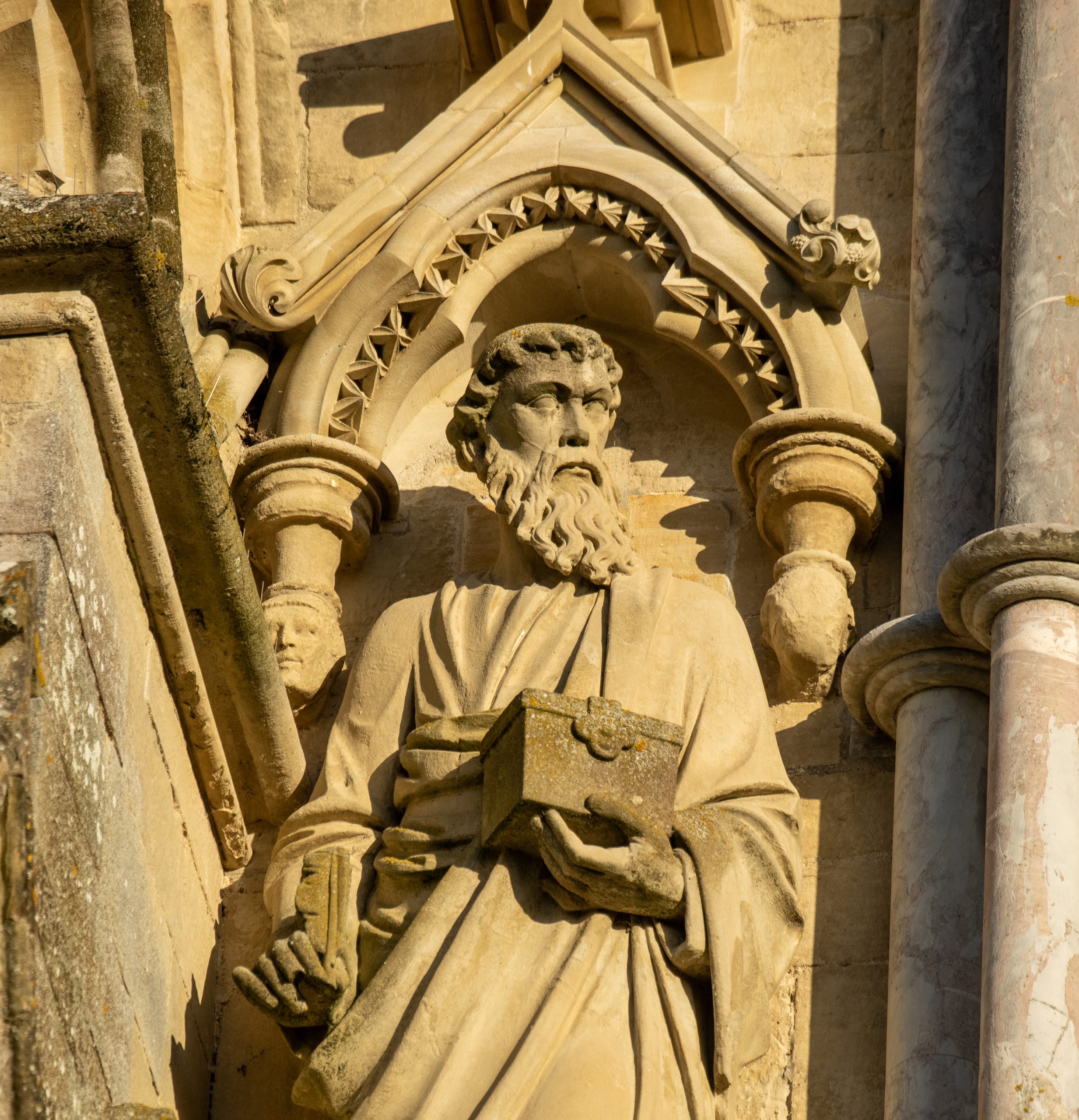
Matthew the Evangelist
A Sermon preached by the Precentor, Canon Anna Macham
Sunday 20 September 2026
Isaiah 33:13-17 and Matthew 6:19-end
Before coming to work here at Salisbury Cathedral, I was parish priest of a small church community off the Old Kent Road in Southeast London. As you can imagine for an inner London borough, the area was densely populated and highly multicultural, and the thing I loved most about this small church family was everyone in it was so different from each other. This frequently caused misunderstandings and clashes of expectations, because so many different cultures, nationalities, languages, educational backgrounds, experiences and ages were represented. I often found it challenging and intriguing in equal measure, because at times I had virtually nothing at all in common with some of the people I was ministering to. I sometimes had to work hard to find any points of connection at all between their experience and mine, let alone understand their perspective. But this was by far the most rewarding aspect of the job- and when I look back, something I will always treasure. There’s an unlikely saying, “The smaller the village, the larger the world”. And it’s certainly true that, in that church, I met and got to know people there’s no way I would have met in any other context, or career I could have done, that I can think of.
But such an experience, I think, is rare. In a small Church, American author Philip Yancey writes, you have to rub shoulders with everybody. Your companions are chosen for you, and you’re forced you to interact with diverse individuals you might otherwise avoid, whereas in larger communities, people can easily pick and choose only friends who are like them. He’s thinking of American megachurches, but the same is true of larger churches or communities here too, I’m sure. It’s human nature to seek like-minded individuals who gather together around a common interest, whether that’s music, being family orientated, or promoting a certain type of intellectual engagement that- if we’re not careful – could exclude those whose approach to faith is different, and whose insights and experience are therefore lost. There’s nothing wrong seeking people we can easily connect with and have things in common with; this reinforces a sense of belonging and is a good thing. But a danger could be that it unwittingly flattens out difference, or worse, when taken to an extreme, creates invisible barriers that mean people who are unlike us feel there is no place for them. This applies in terms of ethnicity, gender, sexuality, age, disability, class and many other ways in which we reinforce a sense of belonging and exclusion.
The feast day whose eve we celebrate this evening challenges that kind of attitude. Matthew is a tax collector. Tonight’s passage from Matthew’s gospel is concerned with right use of money, and if you read on to the account of his calling by Jesus in Chapter 9, you’ll see it’s not unconnected. “As Jesus was walking along, he saw a man called Matthew sitting at the tax booth; and he said to him, “Follow me”. And he got up and followed him.”
Matthew simply gets up and follows Jesus, walking straight out of one way of life and into another. We don’t know much about him. But we do know that tax collectors were universally despised, the hated minions of a corrupt imperial system. For the local population, taxes were a reminder of occupation and subjugation; the taxes levied by Rome kept most of the people in a state of poverty. Tax collectors, who often siphoned off money to line their own pockets, were seen as scum. Their contact with the currency of the empire made them ritually unclean and so cut off from the religious life of Israel. They had chosen corruption and collaboration over the sense of belonging to God’s people and so made themselves outsiders to both covenant and community.
This is the background from which Matthew came. And that’s why Jesus’ call of him scandalised the Pharisees, those upright guardians of religious morality. They know what kind of people belong- what type of behaviour is expected of those who are part of God’s people Israel, and tax collectors are not part of it. Holy people, God’s people, don’t mix with that sort, and God certainly doesn’t mix with them.
Yet Matthew’s outsider status doesn’t seem to bother Jesus. The Pharisees are concerned with why Jesus eats with tax collectors and sinners; a respectable rabbi should keep his distance from such tainted company. Yet Jesus’ understanding of holiness is different, no longer grounded in fidelity to the Pharisees’ interpretation of the Jewish law, which required separation from all that was unclean. For Jesus, holiness is grounded not in separation but in mercy. Mercy is what Jesus offers to Matthew, and to others like him who are used to being shunned. He mixes with him and his type, and eats with them, and in so doing turns Matthew’s life around, so much so that today we honour that same tax collector as a saint, one of the foundation stones of the Church, quite literally if you look at his statue on the West Front of this cathedral, which depicts him holding a box in one hand- representing the treasury of money that he collected before leaving that behind to follow Jesus- and a quill pen to write his Gospel in the other, with the face of an angel at his feet.
It is mercy that compels Matthew to get up from his seat in the tax booth, and the experience of being shown mercy and responding to it that changes his life. Jesus doesn’t say to the tax collectors and sinners, “repent of your sin and offer the requisite sacrifices for your purification, and then I’ll come and eat with you”. He goes and eats with them, accepts hospitality from them, and from that encounter repentance and conversion follow. It’s not our choice of God that makes us disciples, but our response to the fact that God in Christ has already chosen us.
From Matthew, then, we learn something of what it means to respond wholeheartedly to mercy. Most of us are not stigmatised in the way he was, though some of us will have had the experience of being made to feel excluded and unwanted, in society or the Church. For most of us, our need of mercy is more hidden – it’s the shame or guilt or the brokenness we bear secretly, or share only reluctantly. But Jesus looks on each of us, as on Matthew, with mercy and says “follow me”.
Responding to God’s mercy makes us more merciful. It’s harder to judge others harshly when we remember the grace and mercy God has shown us. Whereas the symbol for each of the other evangelists is an animal, Matthew’s symbol traditionally is a human face. The sort of holiness Jesus shows us is the holiness of the incarnation, not separation; a holiness that requires us to get our hands dirty, to mix with the wrong sort, to learn to receive the sort of disreputable hospitality that sets respectable tongues wagging – the sort of holiness, from today’s reading that sees ourselves more as an intrinsic part of God’s physical creation, rather than standing apart from it and exploiting it for personal or financial gain. Too often, in the Church, we practise the holiness of separation, hedging God’s love about with rules and regulations, forming tidy communities of the like-minded. But if tax collectors are suitable company for Christ, then for the Church to properly be the Church, it should be gloriously, scandalously diverse, a haven for sinners as well as a school for saints, a place where all are shown mercy and love, because all have received these things.