


Lessons from History
A sermon preached by Revd Maggie Guillebaud
Sunday 26 July 2026
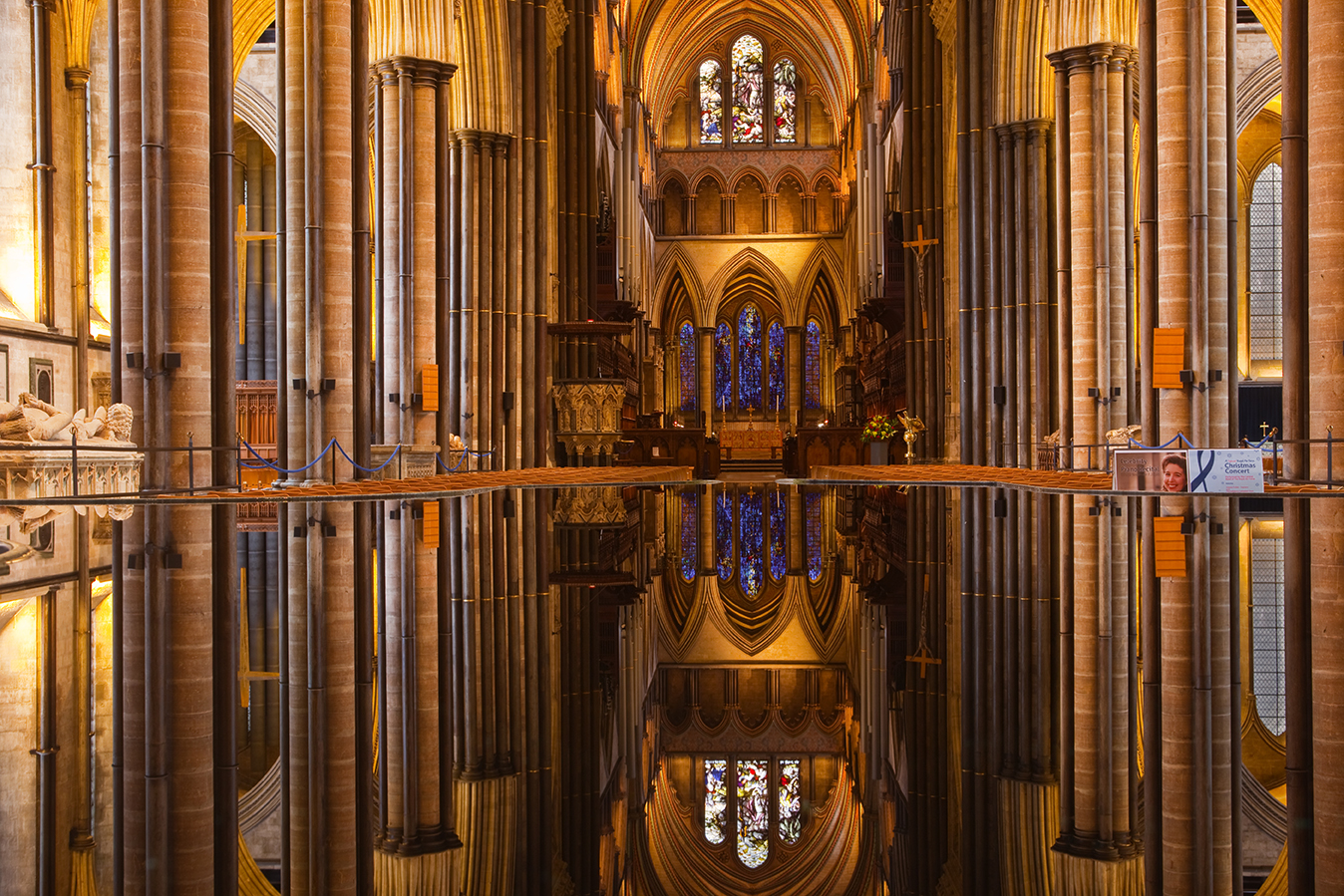
Imagine your ancestors wandering in a desert for 40 years. The great leader Moses led them out of Egypt, that same Moses seen in the stained-glass window behind me above the High Altar here in Salisbury Cathedral. A commanding figure who led his people to the Promised Land, but did not actually enter it himself. But that is another story.
420 years later, after many vicissitudes, another strong and wise leader, King Solomon, decides to commemorate the commencement of what we now call the Exodus with the building of a permanent Temple in Jerusalem to house the Ark of the Covenant, that beautiful object which contained the tablets of the law received by Moses on Mt Sinai, those same tablets which your ancestors had carried throughout their wanderings in the desert.
This relatively small building was to house not only the Ark but also to signify God’s presence with his people in a tangible way. It came with God’s promise that if the children of Israel lived by God’s commandments, they would never be forsaken by him.
The detailed description of the Temple’s furnishings we heard earlier are lovingly remembered, and are meant to stun and awe. This was to be the most beautiful building anyone had ever seen. It was a sign in stone and wood and gold of God’s permanent Covenant with his people. It was here Isaiah would see his great vision of God, the Temple filling with incense as he glimpsed a corner of God’s robe. It was a sign not only of hope but of stability. We are here, we have ceased our wandering, God is with us.
Lessons from history can be illuminating. And were you to go to Jerusalem today you would find only a remnant of the Temple Solomon built, the great West Wall where Jews still come to pray. The Temple remains central, as it has done for thousands of years, to the sense of Jewish identity and faith .
What happened to the Temple?
Well, Solomon’s Temple was destroyed in 587 BC by the Babylonians, and the Jews exiled. It was rebuilt in part first by Zerubbabel in 538, after the Jews returned from Babylon, and then by Herod at the beginning of the 200s BC, but this time on a far grander scale. Herod’s Temple was central to Jesus’ life and ministry, and he and his followers would often meet in Solomon’s Portico.
Then in 70 A.D., barely two generations after the crucifixion of Jesus, the Romans took over Jerusalem and again the Temple was destroyed. By 135 AD most, but not all, of the Jewish people had been expelled from Jerusalem and Judea, many enslaved across the Roman Empire, and Jerusalem became a pagan Roman city, later re-named Aelia Capitolina.
It wasn’t until 1948, when the State of Israel was founded after the Second World War, that Jews finally returned in great numbers, the fragments of a people all but annihilated by the Holocaust, and a new nation emerged as Palestinians, who had lived there for centuries, were displaced. The echoes of this displacement are at the root of current problems in the Middle East. And numerous wars from then until now have kept this tiny nation afloat by the skin of its teeth.
The State of Israel, as we know, is under threat, militarily and existentially. For example, in Palestine Square in Tehran stands an enormous digital clock. It states that the State of Israel will cease to exist by the year 2040. Iranians can watch the sands of time run out, leaving Israel just 50,000 or so days before it ceases to exist. As the late Ayatollah Khamenei told his people in 2024, Israel is a ‘cancerous tumour’. History, as Mark Twain famously observed, ‘does not repeat itself, but it often rhymes.’
What are we, as Christians, to make of all this?
I think this is a profoundly important question. Jerusalem is the centre of three great Abrahamic faiths, and its safety and stability concerns us all. And it happens to be situated in Israel.
There seems little we as individuals can help do to unpick this problem. Complicated international politics are at play. But one thing we can do is to differentiate very precisely between the State of Israel and the Jewish people. Sadly, many do not. We see this in the pro-Palestinian marches through London where frequently no such niceties are observed, and chants of ‘from the river to the sea’ often go unchallenged.
We see it in the setting on fire of Jewish ambulances in Golders Green earlier this year, ambulances which served the entire community, not just the Jewish community.
We see it in the attacks on synagogues, in the increasing fear of law-abiding Jews, who have lived in this country for many peaceful years, simply getting on with their own lives.
And for those old enough to remember the echoes of the Holocaust, the vision of Krystallnacht in Germany, or the Night of Broken Glass, in 1938, when Jewish businesses were looted and closed, windows smashed, 1400 synagogues burned, and the Jews left traumatised and terrified, reminds us that history does not repeat itself, but it often rhymes.
But here’s the thing: being pro-Palestine is an honourable cause, but, and this is important, it can so easily slide into antisemitism if we are not careful. That is where the danger lies. Christians, who honour the fact that Jesus in his earthly form was a Jew, brought up as a Jew, and became a Jewish Rabbi, know that the State of Israel cannot be conflated with a diaspora of a people now dispersed throughout the world. We must fight back against any notion of antisemitism, as indeed we must fight back against those who would see all Muslims as potential terrorists or rapists. Such polarised thinking leads only to distrust and fear, and increased violence. In a civilized society this should not be tolerated.
Has God kept his word to the Jewish people? Yes, I believe he has. The Temple may no longer exist in its entirety, but the Jewish people have survived, survived the Russian pogroms, survived Medieval Europe’s demonization and casual massacring of them, not least by us in York in the Middle Ages, and survived even the Holocaust.
Many deplore what the State of Israel has done, particularly in Gaza and the West Bank. And many Israelis would concur with this, as would many Jews of the diaspora. But the desire for vengeance after the massacre, kidnappings and imprisonment of the victims of 7th October 2023 are factors in the State of Israel’s actions, as is the response of Hammas following the near destruction of Gaza.
But as Christians we remember that Christ told us to ‘love your enemies, and pray for those who persecute you.’ Or as Paul in his letter to the Romans writes: ‘If your enemies are hungry, feed them; if they are thirsty, give them something to drink……. Do not be overcome by evil, but overcome evil with good.’ And we must remember too that Christian War Ethics permit only proportionate responses to attack by an enemy.
This endless circle of violence will not be solved by one act of revenge after another. Nor will outright racism, because that is what antisemitism is: the demonizing of an entire people. Christians should have no part in demonizing anybody, Muslim or Jew, Sikh or Hindu. That is not Christ’s way.
Does history repeat itself? I don’t think so. Does it often rhyme? I believe it does. We must remember the lessons of history. We must not allow the freedoms which we cherish in this country, or in any country, to be hijacked by partial narratives, or by the irrational fear of people who do not look or think like us. Christ’s sacrificial love came to set us free to live in love and hope with one another. Let us cherish that hope, embrace that love, and protect that freedom.
Amen