


The Song of Miriam and Moses
A sermon preached by Canon Kenneth Padley
Sunday 26 July 2026
One of the most amazing scenes in Tolkien’s fantasy epic The Fellowship of the Ring is the flight of the injured hobbit Frodo to the safety of Rivendell, realm of the elf-lord Elrond. Alas Frodo is pursued by the Nazgul, nine undead wraiths on fell steeds who will stop at nothing to seize the ring which he bears. Desperately he gallops the final plain to the Bruinen, the river which marks the edge of Elrond’s kingdom. Exhausted and half-delirious, Frodo fords the stream before glancing back as his pursuers start to cross behind him. Surely all is lost.
At that moment there came a roaring and a rushing: a noise of loud waters rolling many stones. Dimly Frodo saw the river below him rise, and down along its course there came a plumed cavalry of waves…
The black horses were filled with madness, and leaping forward in terror they bore their riders into the rushing flood. Their piercing cries were drowned in the roaring of the river as it carried them away. Then Frodo felt himself falling, and the roaring and confusion seemed to rise and engulf him together with his enemies. He heard and saw no more.[1]
Today we reflect on the biblical scene which surely inspired Tolkien when writing about Frodo’s miraculous rescue at the Bruinen. We heard in today’s first reading of the Hebrews crossing the Red Sea and the waters closing over the pursuing army of Egyptians. Brother and sister Moses and Miriam look back from the safety of the Sinai peninsula – their Rivendell – and strike up a song of celebration:
I will sing to the Lord, who has triumphed gloriously,
the horse and his rider he has thrown into the sea.
This is the story which names the second book of the Bible as Exodus. Even more significantly, this is the story which names the pass-over, that reiterated meal of thanks and praise which is of such significance to Jews and Christians.
Thus Frodo’s crossing of the Bruinen is a story within a story. Tolkien would have termed this ‘fairie’, not a strict allegory of the Exodus, but a tale in which scriptural antecedents are recognisable to those who wish to see them.
In a similar vein, the song of Moses and Miriam is another story within a story. This is because scholars think that this song – arguably the first in the Bible – began as an independent poem which later became embedded in Scripture. The unknown writer of the second book of the Torah wrote a prose narrative of the crossing of the Red Sea which we know as Exodus chapter 14, before inserting a hymn from an earlier hand (presumably sung within their community), and which we know as chapter 15:
I will sing to the Lord, who has triumphed gloriously,
the horse and his rider he has thrown into the sea.
Resonating with the Cathedral’s Joyful Noise season, we will be exploring such Secret Songs of Scripture during our suitably sibilant sermon series on successive Sundays this summer. We will be looking at eight songs in all, running in Biblical order, four from the Hebrew Scriptures and four from the New Testament. Most are like the Song of Miriam and Moses, ancient independent poems incorporated into the Bible, although a couple might have originated the other way around – lines first written in Scripture but later extracted into standalone canticles. Either way, their significance is that the verses are so thematically and rhetorically strong that they form independent songs to God.
As with recent sermon series here at the Cathedral, we are keen to make the most of this sustained learning opportunity. And so we are offering a follow-up discussion group with each preacher. These will be held over zoom on Mondays between 7 and 8 o’clock in the evening. To request the code for the group, please follow the weblink from the ‘Services’ page of the cathedral website You will then be sent a Zoom code on Monday afternoon.
To start us off, however, I’d like us to consider the song of Moses and Miriam from several different angles. It’s not that one is right and the others wrong, but I wonder which perspective is singing to you today?
Firstly, the perspective of victors. The song of Miriam and Moses is a great hymn of praise. Understandably so. It marks the most astonishing rescue in the Old Testament, a demonstration of the power and love of God for his people. For this reason, Christians from the earliest times have drawn comparisons to Jesus, both his power over nature in general (as seen in today’s gospel), and more specifically to the redemption and conquest of Easter.
Such parallels between Exodus and Easter were to the fore when the seventh/eighth century monk, John of Damascus composed his magnificent pascal hymn:
Come, ye faithful, raise the strain
of triumphant gladness!
God hath brought his Israel
into joy from sadness:
loosed from Pharoah’s bitter yoke
Jacob’s sons and daughters;
led them with unmoistened foot
through the Red Sea waters.
John Damascene was only thinking secondarily about the Red Sea of course. His greatest rejoicing was over Christ’s defeat of sin and death through the cross and resurrection.
The Exodus must have been a complex metaphor for Damascene. Later in the hymn he sang about glad Jerusalem welcoming Jesus’ resurrection in unwearied strains. That too must have been metaphor, bearing in mind that he lived at a time when the eastern flank of the Byzantine Empire had collapsed and the Holy Land was under the Umayyad caliphate.
We are starting to see here the multivalent potency of the exodus motif. Long has its imagery of rescue been important to the downtrodden and oppressed. It speaks of salvation against all odds and stamps divine authority on the quest for liberty and liberation. Fired by this vision, the African American spiritualist sang
Deep river, Lord… Oh, deep river,
I want to cross over into campground.
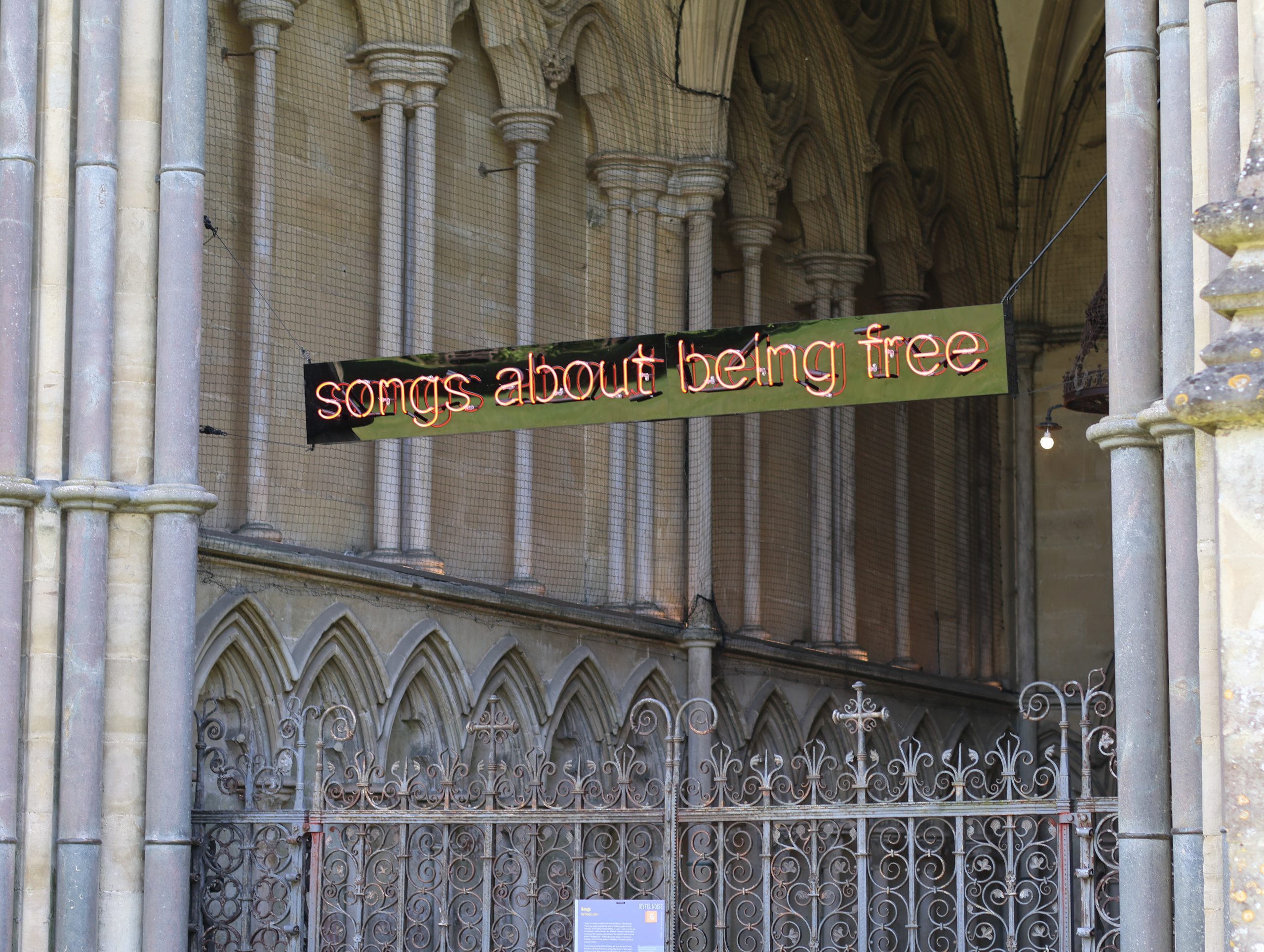
Not without reason have Liberation theologians harnessed the Exodus story in their advocacy of equality and justice. Not without reason did the 1807 abridgement of Scripture intended for enslaved peoples conveniently omit the book Exodus along with all other references to freedom and escape. The story was just too explosive to print in the Slave Bible. As Tim Etchells, contributing artist to this summer’s art installation reminds us, when we pass through the north porch to worship, ‘songs about being free’ have power.
But power has a shadow side. History is written by the victors. What might the song of Miriam and Moses say to an ancient Egyptian about God and his justice?
The horse and his rider he has thrown into the sea.
Read through such a prism, this text which for some is full of rejoicing or liberation to others becomes an ethically troublesome passage. What might it say alongside Russian propaganda in the Donbas, or the positioning of America and Iran about the Straits of Hormuz, or in any zero-sum conflict where protagonists are seeking to dispossess others of land and property?
The horse and his rider he has thrown into the sea.
So one person’s joyful noise can become difficult noise for others; times when we hear too much or too little; times of conscious misrepresentation, obfuscation, silence, and denial.
The horse and his rider he has thrown into the sea.
I look forward to discussing all this and more with those who wish to gather online tomorrow evening. As we uncover this hidden hymn, what song is Jesus singing to you in secret, and what verse and voice does he invite you to resound in his world?
[1] Tolkien, Fellowship of the Ring (1961 edn.), 227.