


Peregrine Blog No 3 2026
Well, another very successful season with the Peregrines at the Cathedral has come to an end.
From a clutch of four eggs, four chicks hatched and all fledged successfully. It certainly is the case that the Cathedral has been an amazingly successful location for Peregrines since they first reoccupied the site after a gap of many years in 2013. The nesting attempt in that year was not successful as the three eggs were laid on the stone walkway on the southern side of the Cathedral and somewhat predictably, the eggs rolled apart, chilled and were deserted. A nest box was installed over the following winter, and the falcons took to it and bred the following year successfully; they have never looked back since.
It is interesting to review the success of the falcons since they first reoccupied the site in 2013. Since that first reoccupation, we have had 13 nesting attempts; no breeding took place in 2018 due to territorial disputes which led to the replacement of the then resident pair. In that time we have had 13 clutches of eggs, ten of four eggs, two of three and one of five; a total of 51 eggs. This is an average clutch size of 3.92 eggs, which is fairly typical for Peregrines in urban locations. We have had 41 chicks fledged from these eggs which is an average per nesting attempt of 3.15 chicks. This is particularly good even for an urban nesting site. I have ignored in this total the one chick we had fostered into the nest from Shropshire in 2017. All 41 chicks have been ringed and in recent years DNA swabs have been taken too, which is now quite commonly done nationally to aid identification of individual birds in cases where illegal activity involving birds might be involved. As I have alluded to in previous years, the high success rate is probably to a significant degree due to the location of the nestbox (well, the third nest box in fact) located about a metre down below the parapet wall on the south face. Not only does this parapet wall, together with its bespoke ‘sun shade ’, provide shade and some shelter for the chicks in hot and wet weather, it also minimises the risk of ’ fallers’, i.e. chicks attempting to fledge before they are really ready to do so. From some nest boxes elsewhere in the UK, and of course on open ledges on natural nest sites on crags and sea cliffs, it is all too easy for chicks to fall out of the nest or attempt to fledge before they are really ready to fly with any confidence. Whilst some ‘fallers’, especially in urban areas, can be rescued and returned to their nest box, many, especially in more rural locations will sadly perish. ‘Our chicks’, if I may call them that, have to be able to fly to a reasonable degree of competence to be able to fly up from the walkway where they were born to the top of the parapet wall from which they subsequently launch themselves into the world, so to speak. If memory serves, we have had only three ‘fallers’ at the cathedral since 2014, and all were successfully rescued and returned to the nest site on the southern walkway.
Regular followers of the Peregrines will know that, as in past years, the four chicks have been named. The theme for this year was ‘Joyful Noise ’, and 350 submissions were received from the public. The decision was taken, as we had two male and two female chicks, to name them after the members of the pop group Abba. As being from a generation that can still remember Abba in their heyday, I think their music was certainly excellent and could certainly be described as ‘joyful’; not quite sure how the members of the band would have regarded the ‘noise’ bit; but whatever, we are all signed up and ‘Thank you for the music’ still rings true today.
As in past years, the South Wiltshire local RSPB group, in conjunction with the Cathedral, ran their usual ‘Date with Nature’ event in The Close from mid-June until early July. In all previous years, we have set up the stand with information and telescopes just outside the entrance to the Cloisters on the south-western side of the Cathedral. It soon became apparent that in 2026 we would have to move position as the fledged chicks and the two adults spent most of their time perched on the north side of the building. I suspect that this was due to the very hot weather we experienced throughout almost all of the duration of the ‘Date with Nature’ event, the birds wisely choosing to perch on the north side of the building where they were in the shade at the hottest times of the day. Accordingly, the stand and telescopes were positioned in The Close on the north-western side of the Cathedral and, being set a little further back from the Cathedral in this new position, I think we enjoyed mostly better views of the birds than in past years.
As ever, visitors from many parts of the world came to view the falcons through the telescopes, and very few were disappointed as birds were on view for most of the time the volunteers from the RSPB were present. It is always nice to chat to visitors, many of whom have not seen a Peregrine before. Many visitors were Salisbury residents who had followed the progress of the birds either through watching the birds on the live webcam on their computers at home or perhaps hearing the birds when they have walked through The Close on their daily travels. It was great to be able to show them the birds in the flesh, so to speak. In addition to sightings of the falcons, we have seen a number of Kites and Buzzards drifting over the Cathedral, and I was lucky enough on a day when I was ‘on duty ’, so to speak, to have an Osprey fly almost directly over the spire itself.
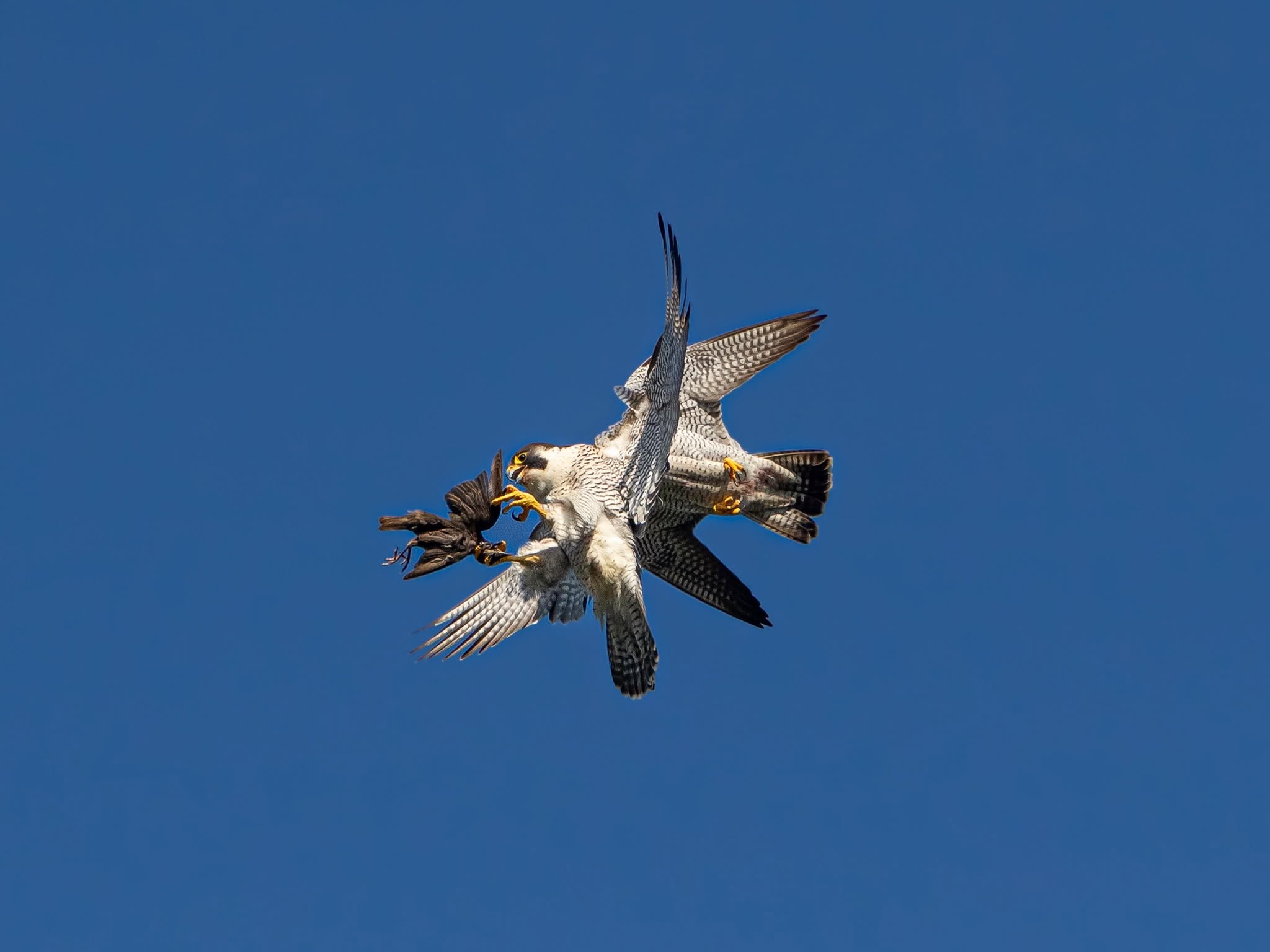
I think since the weather was very hot during most of the time the ‘Date with Nature’ stand was manned, we saw relatively few prey items being brought to the Cathedral by the adult birds. I suspect that most of the hunting by the adults was done relatively early and late in the day when the weather was a little cooler. That said, I was lucky to be manning the telescopes on one day when the adult female did fly in from the north with a corvid in its talons. Three of the juveniles flew out to meet her and had a tussle to try and grab the prey item from her. One juvenile did so but unfortunately, perhaps because the prey item was quite large, managed to drop it and it landed on the grass in the grounds of The Close not too far away from several people who were probably quite startled as to the sudden appearance of a dead bird just falling from the sky. The bird was not retrieved by the adult or chicks from the grass, so I wandered over to take a look and found that the victim was a fully grown Carrion Crow. It was still there when we left mid-afternoon. This tussle between juveniles for prey items being brought in by the adults is very common, and in most years we have seen prey items dropped like this and not retrieved. Whilst sometimes juveniles do share prey items, normally the juvenile that succeeds in grabbing the prey item from the adult is very possessive of it; a case of ‘The winner takes it all’ to continue the Abba theme. As for the Carrion Crow, alas it met its ‘Waterloo’!
All that now remains is to clear up the prey remains and various bits of assorted debris from the walkway beside the nest box sometime, probably in mid-August, by which time most of the juveniles will have left the site for good or only come back intermittently until early autumn. The adults will be present on site throughout the autumn and winter, and it will not be too long before we see the first signs of the 2027 nesting season, probably towards the end of January 2027. I, for one, cannot wait.
Granville Pictor 26 July 2026.