


I am the Door
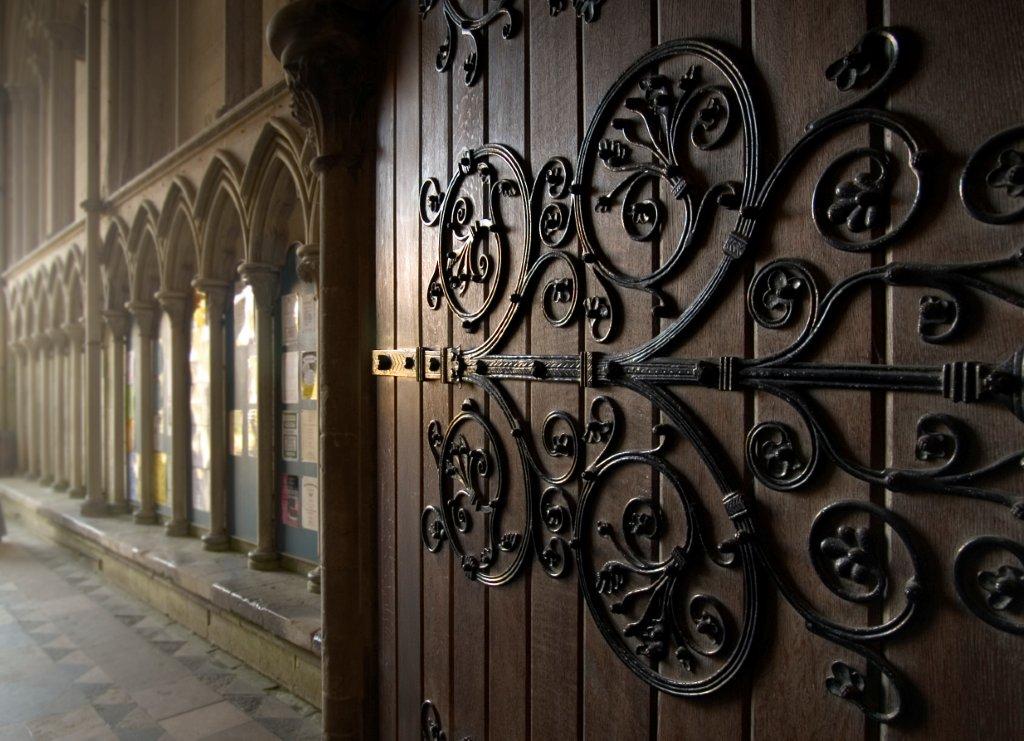
‘I am the Door’
Preached by the Precentor, Canon Anna Macham
Sunday 26 April 2026, the Fourth Sunday of Easter
Acts 2: 42-end and John 10: 1-10
One of the things I’ve grown to love about this Cathedral, since starting to work here 7 years ago, is the walk through the Cloisters at the end of the afternoon before daily Evensong each evening. Rushing over from our Cathedral offices, often with only a few minutes to spare, this regular walk through the Cloister and into the hushed Cathedral has often been one of the most magical parts of my day, giving a chance after all the stress and busyness and the day’s sometimes relentless demands to refocus and gain some perspective. There’s something very impactful about this building that, unlike other impressive or beautiful places I’ve had the good fortune to work or study in, always – in my experience, at least – makes an impression and lifts your mood, however many times you encounter it, that you never come to take for granted.
But if you never came through the Cloister door, you would never see any of this. The entrance to the Cloister is possibly the most humble of all the doors into the Cathedral, and – while it’s still quite good by general standards! – is not particularly prepossessing in comparison either to the other main doors or to what lies inside it, even though it’s now accompanied by the beautiful outside Easter Garden.
Doors are incredibly important. It goes without saying that, while the building continues to make an impression, a pitfall of working in a place like this for a long time is that it’s easy to forget how it feels to someone experiencing it for the first time who may be afraid to come in. And then there’s the opposite experience. One of the questions I most frequently get asked by visitors at the end of Evensong is how to get out. Such is the scale and awe-inspiring magnitude of this building that many people simply get lost inside.
In our Gospel reading today, Jesus says “I am the door”. He then says “I am the Good Shepherd” in verse 11, immediately after today’s section, but first he says “I am the door”. The modern, NRSV translation we just heard has “I am the gate” – which feels a more natural way to describe the opening in a stone enclosure for sheep. But the same word – thyra in Greek – is used elsewhere for the door of a room – for example, when Jesus says in the Sermon on the Mount in Matthew’s Gospel: “Whenever you pray, go into your room and shut the door and pray to your Father who is in secret”.
A door gives you a foretaste. The doors of this or any church are like a chapter heading or front cover of a book, that’s waiting to be opened- they whet the appetite, preparing you for the story that is to unfold. And yet doorways, like chapter headings, are sometimes the most easily ignored, mostly skipped over as we impatiently turn the page to find out what happens next.
Yet doorways are significant for our human journey. They say to us that how we come into this building and how we leave it are significant matters. It’s as though the entry and exit points say something about human life, and how we cross the thresholds of our human pilgrimage. The cool, soaring elegance of the north porch speaks of space and sanctuary and hospitality away from the noisy bustle and pace of the city. “Come to me all you that are weary and are carrying heavy burdens, and I will give you rest” it seems to say, anticipating the words around the nave altar inside. This is a door we surely can’t ignore. It seems to offer access from one world into another.
And the great west doors, grand and awe inspiring though they are, are not simply for the grand and the good. The exuberance of the arcading, the layer on layer of arches within arches – even while they say something about human cleverness and ingenuity and the skill of the masons who made them – also say something powerful about God – and her super-abundance and extravagance towards us. The west front tells the story of redemption, of annunciation and birth, of death and resurrection, of ascension and divine sovereignty – a story in stone. And emerging out of this, flanking it, interpreting it and fleshing it out are the lives of the saints, whose witness points to the truth of the central revelation of God’s love revealed in Christ. These doors invite us not just to admire this story from afar, as though it was a remote, petrified fairy tale. They invite us to enter in and be discovered by God, discovering for ourselves how the story of Jesus and his love for us is as relevant and resourceful and reassuring as it was for those saints who look down on us from their stone niches.
Wherever they are situated, the doors of the Cathedral point in one direction: towards Christ, and his story; to Christ, who is the door. The doors invite us to a place of shelter, of security and safety: not just away from the relentless traffic of life but to a more profound and enduring peace. But just as we can ignore the doors into the Cathedral as we pass on to its greater treasures, so we can ignore the idea of Jesus as the door. As we read on in John’s Gospel, John piles image on image on top of another, stretching and challenging the imaginations of his readers as we try to imagine and define the life-changing reality of God in Jesus. But while there are lots of artistic representations of Jesus as the Good Shepherd, there are very few of Jesus as a door.
But the door is important because it pinpoints the threshold, the moment of decision, of growing up, of making judgements, seizing the moment. When we move from being a teenager to an adult, when we start a new job or are made redundant, when we fall in or out love, face illness, lose a loved one or face death, these are threshold moments, and entering a place like this should help us deal with these moments of grief and happiness, and achievement and failure, and hope and despair. Jesus, who is the door, is not standing ajar and letting us merely pass through, to face it on our own. The door is the moment of transition, the door is part of the pilgrimage, the door is the decision point, the growing into maturity. And Jesus the door is saying, I am there in it: I am deciding with you, I am travelling with you on the journey, growing up with you, facing life and death with you; I am in your failure and limitations just as I am in your success and achievements. I am the door because I am the way, and travel with you.
The Christian life is often described in terms of perfection, in terms of arrival or certainty. We’ve seen in recent weeks a world leader who models himself on the good shepherd, yet- in the imagery of today’s reading- is more like a wolf in sheep’s clothing, a self-proclaimed Saviour who promises security and freedom, but whose actions turn out to reveal a complete lack of compassion or kindness. But Jesus the Good Shepherd represents an alternative way, the door through we embark on a journey that’s risky for sure, but full of abundant life, and where our needs are met abundantly.
We gather inside the doors, in the relative safety of this Cathedral, to hear the story of a God who in the death of his Son risked everything out of love of humankind. We take the risk of sharing the bread that binds us into the story, and of sharing the cup of pain that is God’s gift to us.
And then we open again the same doors that have invited us to a place of safety and sanctuary, that launch us back into a place of danger and hostility as we leave through them. But Jesus is still the door on the way out just as he was on the way in. He is still travelling with us, crossing the threshold with us. Wherever we go, whatever further doors we must enter, he is still encouraging us by his own example to see the Christian story as a risk to be lived with love.