


We need to talk about Adam and Eve
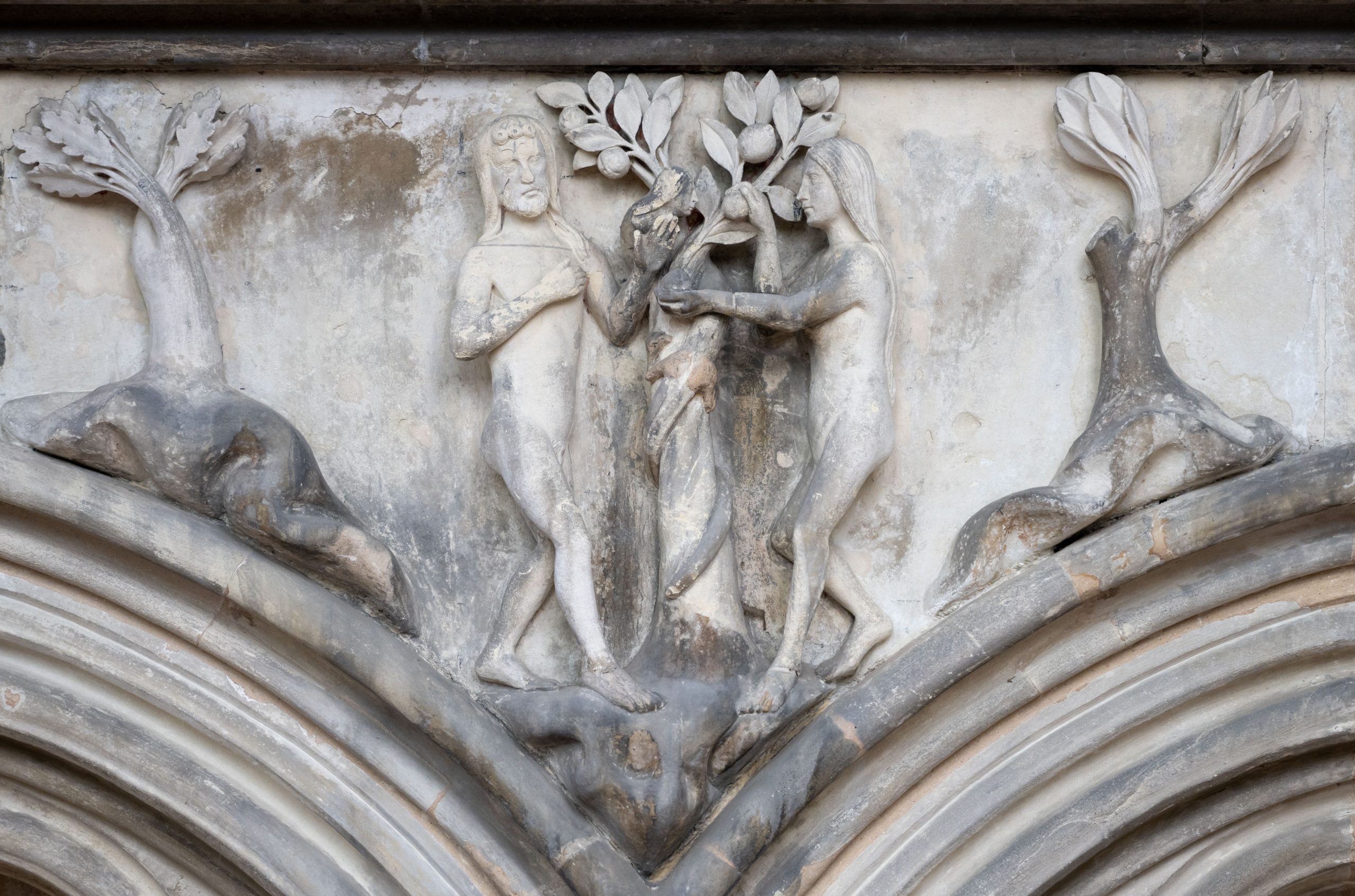
A sermon by Kenneth Padley for the First Sunday in Lent
Reading: Genesis 2.15-17, 3.1-7
We need to talk about Adam and Eve.
The story of the Fall is one of the best-known narratives in the Bible. But, despite this, Christians spend little time thinking about it theologically.
Just pause for a minute to note how the iconography of Adam and Eve pervades contemporary culture. The Eden Project is a botanical conservation scheme and visitor attraction in Cornwall. The Tree of Knowledge is a company which runs business training programmes. The Tree of Life is a coming-of-age drama which won the 2011 Palme d’Or. Forbidden Fruits is a 2026 film about witches. Fig Leaves is a retailer of intimate apparel. Genesis make music. The Adam and Eve sells beer and food, and cockneys rhyme about the first couple when discussing their beliefs. Most significantly, we encounter the enduring legacy of the Fall whenever someone turns on an Apple computer or downloads an App. That bitten fruit has become a universally recognised symbol of human potential when assisted by twenty-first century information technology.
But we need to talk about Adam and Eve because even though the first couple are so culturally recognisable, I think that Christians are nervous discussing them. I can’t recall when I last heard a sermon about Adam and Eve – can you?
I suspect there are two reasons for this reticence. First, we have not entirely escaped a deep-seated Victorian prudishness which avoids conversation about human bodies. There is something about Adam and Eve which titillates yet embarrasses even modern British sensibilities. More significantly, I think we are cautious to talk about Adam and Eve because of the historic controversiality surrounding the publication of the theory of evolution. Charles Darwin’s Origin of Species introduced the idea that biological complexity is a result of a gradual process of natural selection and evinced initial hostility from some leading Christians. Most famously, the Bishop of Oxford Samuel Wilberforce is alleged to have asked Darwin’s supporter Thomas Huxley whether he claimed descent from a monkey through his grandfather or grandmother. Hearing those words today challenges us to a fresh sense of humility and constructive engagement.
Defensive adversarialism to advances in science gives rise to a conflict model which portrays religion as reactionary and retreating. Few scientists subscribe to such a binary relationship between their disciplines and faith traditions. However, the conflict model has become a trope through which populist communicators and influencers can generate cheap laughs and seemingly irrefutable arguments at the expense of people of faith.
There are lessons here about a Christian approach to epistemology, the process by which we come to know things. No Church has privileged access to academic truth. Our claim is that the Bible contains all things necessary to salvation, not that it contains all things. Indeed, we should acknowledge the expertise of scholars in their disciplines. Biologists are experts in biology, just as much as linguists in language and mathematicians in maths. We should praise God for their skills, pray for the beneficial outputs of their research, and defer to their conclusions – by which I mean defer to the academic consensus because unanimity is rarely achieved in any scholarly community.
If we are secure in this constructive attitude towards academic progress, we can talk about Adam and Eve with renewed confidence. It is a framework which not only gives us a positive basis for conversation with science but which also shapes our approach to history, the Bible and the human condition. The implications for history are evident in that the infamous dating of creation by seventeenth-century Archbishop James Ussher to 23rd October 4004BC is clearly a little bit tight. Instead, we should accept the consensus of physicists who locate the Big Bang some 13.8 billion years ago, in the same way that we respect the consensus among biologists that evolution is the product of genetic mutation.
This in turn shines a light on scriptural genre. Much of the Bible is ancient historiography, an attempt to record and explain the significance of past events and people. But Adam and Eve do not fall into this category – in which case we are left with the question why anyone felt the need to invent them?
The story of the Fall is what theologians call etiological myth, a tale which seeks to explain the causes of things. Within the opening chapters of Genesis there are two such narratives. The first, Genesis 1, is a systematic account of creation which asserts that God is the originator of all things, the one who brings order out of chaos. God made this and this and this and saw that each was good. Genesis chapter 1 chapter is then followed by a second etiological myth in Genesis 2 and 3. Here we find a much more earthy account of human origins which uses the characters of Adam and Eve to explain human particularity within the animal kingdom.
The early Hebraic storyteller who spun this tale of our symbolic ancestors was reaching for an explanation of the distinctiveness of human thought and speech, skill and power. Crucially they were also seeking one more thing. They understood humans to be uniquely gifted and blessed – but also knew that we are flawed and impaired. Our lives are wracked by brokenness and suffering, evil and unfairness.
This is why we particularly need to talk about Adam and Eve in Lent, because the myth of the Fall is an honest grappling with the truth of the human condition. The theory of evolution does away with Saint Augustine’s idea that sin is a congenital taint passed from parent to child that can be traced to our pre-lapsarian progenitors. But we can all recognise imperfection in each of us, limitations which map onto biblical concepts of fall and guilt. Science requires us to adjust the lens through which we read scripture, but we still know that sin is innate – none of us can escape it.
There are several modern alternatives to Augustine’s explanation for original sin. Reinhold Niebuhr cited anxiety as the fear which makes us grab more than our fair share of the earth’s resources. Rene Girard wrote of the universal power of envy, each of us wanting that which others have – not so much for the things themselves but simply because others have them.
These traits are inherent to each of our beings. Sin would not be original if they weren’t. We call them to mind every time we come to worship and confess our faults to God before one another. But in particular the Church sets aside this season which have just entered as an exhortation to reflection and repentance, an invitation to become more like Jesus as we trace afresh his temptations trials and passion, and a preparation for the greatest of feasts through which we are assured that God in Jesus resolves the conundrum at the heart of human nature and which the opening chapters of Genesis lay bare. We need to talk about Adam and Eve because Adam and Eve are each of us.