


The Baptism of Christ
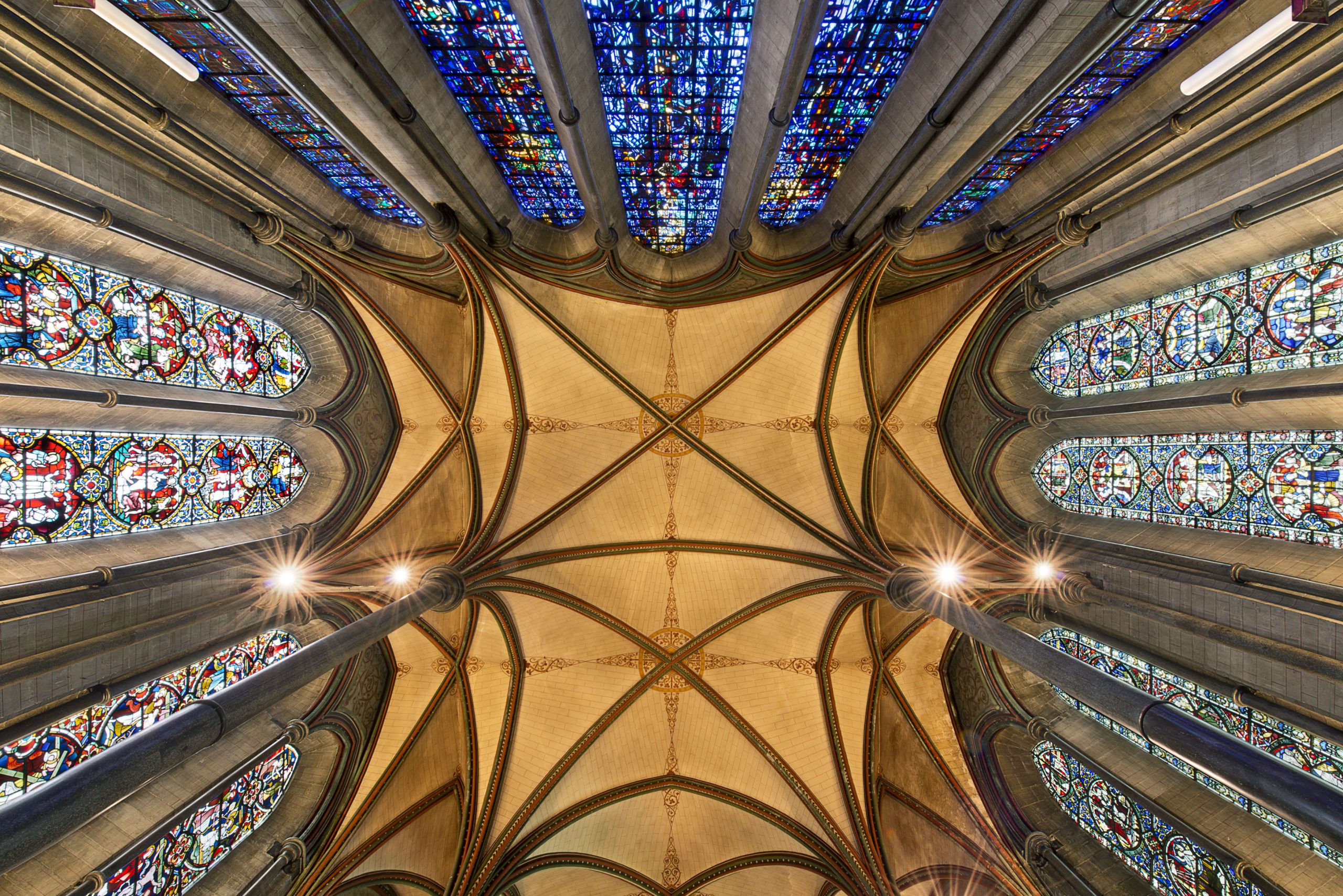
A Sermon preached by the Precentor, Canon Anna Macham
Sunday 11 January 2026
Joshua 3:1-8; 14-end and Hebrews 1:1-12
Today is the Feast of the Baptism of Christ. Occurring on the first Sunday after Epiphany each year, the baptism occurs in 3 Gospels, Matthew, Mark and Luke, near the start of Jesus’ ministry, and is strongly alluded to near the start of John.
Just as baptism marks the beginning of any Christian’s journey of faith, the baptism of Jesus marks the start of his ministry, as he takes up his calling and mission to be the Son of God and all that that entails. The reason we celebrate it in Epiphany is that it’s the second thing, after the coming of the Wise Men with their gifts, that reveals something deeper of who Jesus really is.
On one level, Jesus is baptised by John the Baptist in the river Jordan, just like everybody else – like all the penitents who gathered on its muddy banks, in the wilderness of Judea, who came to receive baptism. But on another, deeper level, it reveals something really significant about his divine identity. “You are my Son, the Beloved; with you I am well pleased”. These divine words spoken over Jesus in the Gospel accounts probably allude to various Old Testament passages, including Psalm 2:7, which our second reading from the letter to the Hebrews this evening also alludes to, when it says in verse 5, “You are my Son; today I have begotten you”. At his baptism, Jesus is declared to be Son of God. He is God’s servant, who will suffer and die for the sins of the people, the Son who will be sacrificed, and who is divinely called by God’s Spirit. All of these allusions hint at what Jesus’ mission as Son of God is going to mean to him, and also to his Father.
Since early times, people have struggled with Jesus’ baptism. On its simplest level, the meaning of baptism or christening as we have received it 2,000 years later – and to which we now give the slightly mystifying name of “sacrament” – is easy to define. Just as we are fed at the Eucharist, the other main sacrament of the Church – our souls and bodies nourished with food – so at our baptism we are cleaned, or cleansed, with water. Holy Communion tells us that our souls need food and nourishment, just like our bodies; and baptism reminds us that the soul, like the body, needs cleansing too. In washing us clean, God removes the stains of sin from our lives, yet Jesus himself is sinless – so how can it make sense for him to have been baptised?
The common explanation given is that in being baptised, Jesus shows solidarity with us. He has to be baptised to show us the way, and give us the example to follow, and to identify with our humanness. But it’s also about more than that. Scripture tells us that washing isn’t the only meaning of baptism. As Paul’s letters make clear, baptism is a kind of drowning of the old self.
In the story of Jesus’ baptism, he goes down into the water, and when he comes up out of the water, the Holy Spirit descends on him in the form of a dove, and, as we have heard, a divine voice speaks from heaven, “You are my Son”. This recalls the story of creation, where the book of Genesis tells us that at the start there was watery chaos, and over that chaos the Holy Spirit hovered, or a great wind blew. First, there is chaos, then there is the wind of God’s Spirit, and out of the watery chaos comes the world. And God says “This is good”. Just as the first creation is associated with water, the Spirit and the voice, so early Christians began to associate baptism with new creation.
Later on in the Gospels, when Jesus is transfigured, God speaks again, using similar words, “The is my Son, the Beloved; listen to him!” This time the words are not addressed to Jesus himself, but to his disciples. For them, as for us, the beginning of Christian life is a new beginning of God’s creative work. Just as Jesus came up out of the water, receiving the Spirit and hearing the voice of the Father, so for the newly baptised Christian, the voice of God says, “You are my Son,” “You are my daughter”, as that person begins their new life in relationship with Jesus.
Many Eastern Orthodox icons depict Jesus surrounded by waves, engulfed by the water; underfoot are pagan river gods who personify the waters of the Jordan, the old world that is being overcome. Above are angels and the Holy Spirit which symbolises the revelation of the Trinity. Just as Jesus himself is a Son, in the waters of baptism we are reborn as a daughter or son of God, chaos moving into order as the wind of God blows upon it.
At this turning point in the year, and as we move properly into the second quarter of this century, it seems as if the opposite is true, that the world order as we knew it is fundamentally changing. With big shifts in international relations, it could seem that order is being replaced by chaos, or something worse. And our own lives, if not chaotic, might not seem like they particularly have more potential now than at any other time to become more ordered; it might be more realistic, especially as we get older, to think less of new year’s resolutions than of self-awareness, or knowing our limitations.
Yet, because of our baptism, our humanity is restored. As former Archbishop of Canterbury Rowan Williams puts it, “To be baptised is to recover the humanity that God first intended.” (Rowan Williams, Being Christian: Baptism, Bible, Eucharist, Prayer, SPCK, 2014). God intends that, as baptised Christians, we will keeping growing in love for him, and that we will grow in confidence that we can rightly be called his sons and daughters, just as he promises us that he loves us and will help us grow in love, even as we remain deeply immersed – like Jesus – in the increasingly chaotic world around us and the muddle within ourselves too. At this Epiphany, as we recall the promises made at our baptism, and the promise of God to be with us, as he pledged to be with Jesus at the start of his ministry, may we at the start of this new year reach out our hand from the depths of chaos and the darkness and uncertainty of our world, to be touched by the hand of God.
I finish with a poem by R S Thomas, entitled ‘The Coming’, in which Jesus accepts his mission to come and be with sinful humanity, and to bring restoration.
And God held in his hand
A small globe. Look he said.
The son looked. Far off,
As through water, he saw
A scorched land of fierce
Colour. The light burned
There; crusted buildings
Cast their shadows: a bright
Serpent, a river
Uncoiled itself, radiant
With slime.
On a bare
Hill a bare tree saddened
The sky. Many People
Held out their thin arms
To it, as though waiting
For a vanished April
To return to its crossed
Boughs. The son watched
Them. Let me go there, he said.