


One body through the cross
A sermon preached by Revd Kenneth Padley
Sunday 13 September 2026
Ephesians 2.11-end
Seventeen hundred years ago, in AD326, an elderly woman was travelling across the Middle East. She was engaged in a unique trip which combined elements of personal pilgrimage, diplomatic mission, and archaeological excavation. Amid the ruins of a once great city she is said to have made an extraordinary discovery.
This woman happened to be mother of the Roman Emperor. The ruins which she was exploring were the remnants of Jerusalem. And the discovery of Helena – at least according to later legend – was nothing less than the wood of the cross on which Jesus died.
Helena did not live to see it, but nine years later, on today’s date, thirteenth of September, a basilica officially opened above the site of her excavations. It is the Church of the Holy Sepulchre. The following day, September 14th, Helena’s relic of the cross was revealed for public veneration for the first time. Hence Holy Cross Day, a date distinct from Good Friday for reflection on the meaning of the means of our redemption.
The conversion of the Emperor Constantine and his family to Christianity in the early fourth century transformed both the fortunes of the Church and its iconography. Today the cross is universally recognisable as the symbol of our faith. But persecuted early Christians had not used the cross as a logo. They preferred the image of the fish, the Greek letters of which, ichthus, form an acrostic code for ‘Jesus Christ, God’s Son, Saviour’.
Imperial backing ditched the need for such secrecy. Moreover, by banning crucifixion as a means of capital punishment, Constantine helped disassociate the cross from the reason it was invented, to serve as a degrading and agonizing form of execution for slaves, foreigners and those at the bottom of the social pile. Instead, Roman Christians soon lauded it as the sign of salvation.
Deep myths soon grew up around the cross of Jesus. These are typified by the thirteenth-century Golden Legend, a vibrant if speculative hagiography by Jacob Voragine, bishop of Genoa. The Golden Legend was a spiritual bestseller, one of the most widely circulated books of the later Middle Ages. Writing about the holy cross, Voragine told of when the first man Adam lay dying, and his son Seth returned to the Garden of Eden in search of medical assistance. The archangel Michael met Seth and gave him a branch from the tree under which Adam had committed his sin. Michael informed Seth that, when the branch bore fruit, his father would be made whole. Filled with hope, Seth hurried home. However, alas, Adam had already died. Seth had failed to comprehend Michael’s message, but in a final act of devotion, he planted the branch above his father’s grave. In time it grew into a great tree which, the bishop of Genoa claimed, would later be harvested for the wood of the cross, thus fulfilling the angel’s prophecy that when the branch bore fruit, Seth’s father would be made whole. Or as St Paul had put it a millennium earlier, as in Adam all die, even so in Christ shall all be made alive.
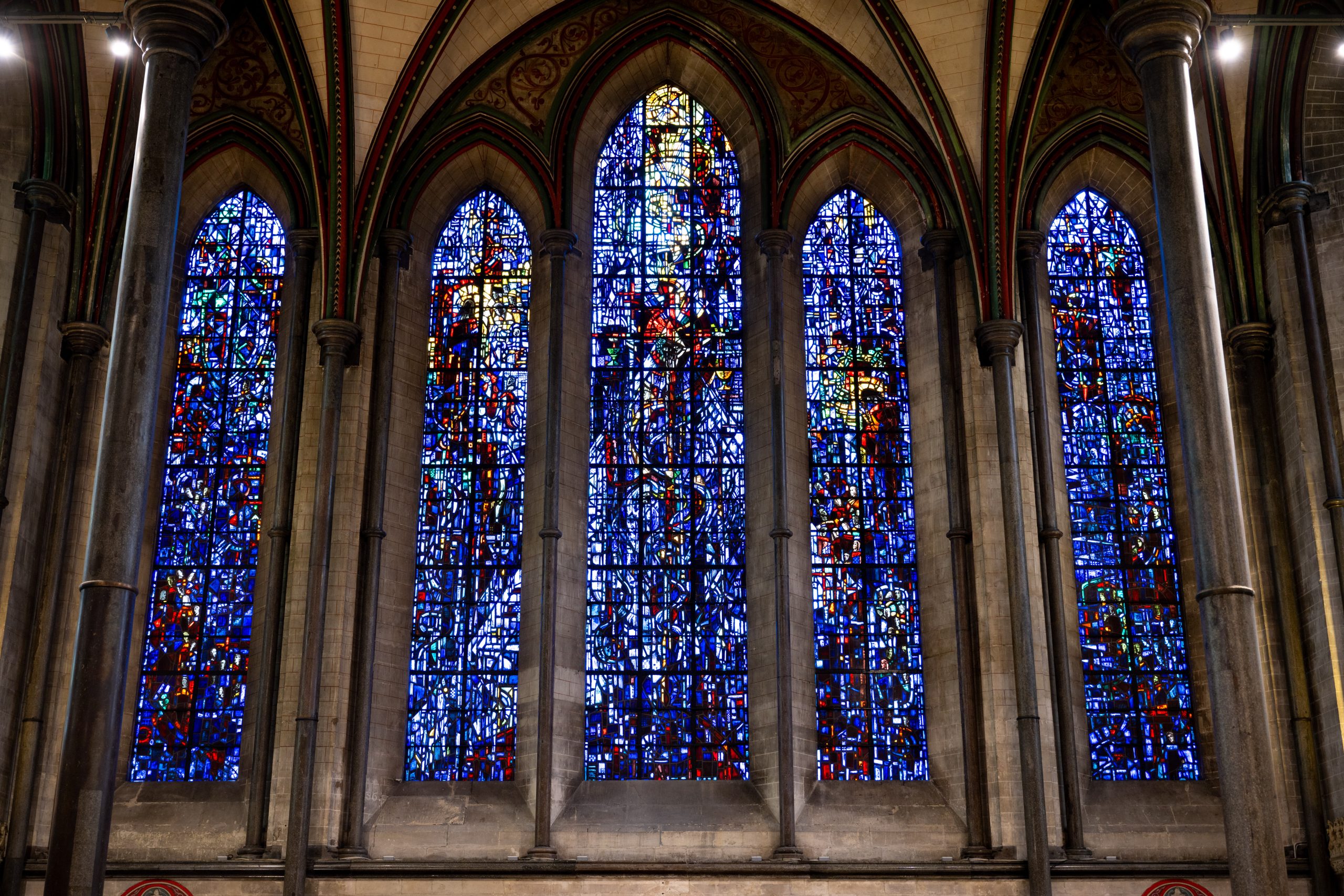
There are variations and continuations of Voragine’s story, and it is related to the artistic commonplace which depicts the skull of Adam beneath the cross of Jesus. I believe this tradition is the origin of the dark hemisphere which can be made out in some lights at the bottom of the middle of our east window. Here is calvary, the burial mound of Adam, at the foot of Gabriel Loire’s great contemporary representation of the crucifixion.
Needless to say, that story about Seth and the tree from Eden owes more to theological elegance than historical accuracy. Even Voragine – a truly masterful weaver of mythical nonsense – adds a disclaimer to this tale that ‘whether any of this is true we leave to the reader’s judgment because none of it is found in any authentic chronicle or history’.[1]
Thus, despite the great service of Constantine and Helena in promoting the cross as artefact and emblem, it still remains a subject of controversiality. Take, for example, the largest cross in the world. This dominates the skyline to the northwest of the Spanish capital city Madrid. Standing at 150-metres tall, this cross stretches even higher than the spire of Salisbury. The problem is that it marks the Valley of the Fallen, General Franco’s monument to the Spanish civil war. It glorifies the deaths of more than 30,000 whose bodies were swept from the battlefields and entombed in the Valley in the 1950s.
In recent years the Spanish government has sought to detach the Valley and its cross from the legacy of Francoist propaganda. They have disinterred the general from the Valley and in 2022 passed a Democratic Memory Law which tries to put the victims of the civil war and not the victors at the heart of public commemoration. It does this by seeking a more open conversation about the past in public life and school curriculum. The new law will not remove the cross from the Valley of the Fallen, but – to the consternation of some Spanish traditionalists – does, effectively, reinterpret it.[2]
Spain of course is not alone. Here in the UK, for example, Stephen Yaxley-Lennon and others have sought to harness the imagery of the cross at anti-immigration Unite the Nation rallies. Playing on this language, the Church of England has recommitted to ‘Promoting Unity in the Nation’, working at local and national level to encourage a healthy patriotism, arguing that the cross of St George can serve as a symbol of pride for everyone in this country.
So there is tension in the cross. Its very symbolism, the intersection of vertical and horizontal, effects and represents both a meeting point and a blockage. St Paul lived this paradox. He wrote to the Corinthians about the cross as a locus of crisis and judgement. However, (as we heard earlier) he also told the Ephesians about how the cross tears down barriers which people put up between themselves.
The judgement of the cross requires each of us to assess Christ’s claims and call on our lives for ourselves. The result is a faith which is personal to every Christian. Nonetheless, to say that faith is personal is not the same as saying it is individualistic. What Paul was telling the Ephesians is that the cross is part of what makes us Catholic, a universal community which transcends the obstacles of place and history, including the inherited barriers which have historically divided different Christian denominations.
Christ has abolished the Law … so that he might create in himself one new humanity … [reconciling] both groups to God in one body through the cross… So he came and proclaimed peace to you who were far off and peace to those who were near; for through him both of us have access in one Spirit to the Father… [Y]ou are no longer strangers and aliens, but … citizens with the saints and also members of the household of God.
Thanks be to God.
[1] Jacobus Voragine, The Golden Legend § 68.
[2] https://www.bbc.co.uk/sounds/play/m002yvwd BBC Radio 4 Sunday 12th July 2026, especially from 18:48.