


Dungeons and Dragons
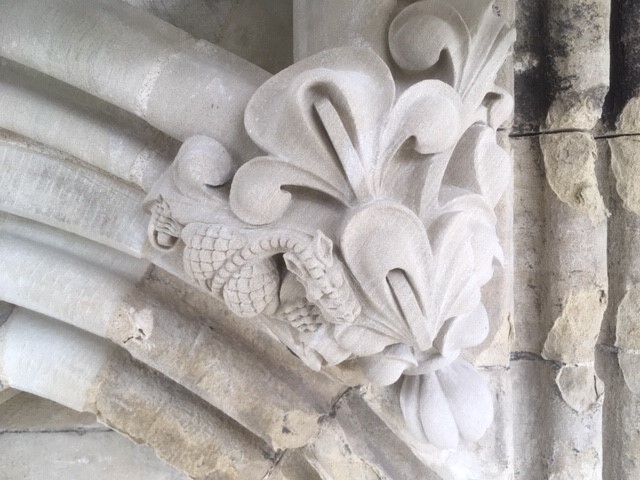
A sermon preached by the Very Revd. Nicholas Papadopulos, Dean of Salisbury
Sunday 23 August 2026
Isaiah 61: 1–9
2 Corinthians 6: 1–10
‘There was a boy called Eustace Clarence Scrubb, and he almost deserved it’. It’s fifty years since I first read The Voyage of the Dawn Treader, the fifth instalment in CS Lewis’s Narnia series. I have never forgotten its opening line, with which I began, and in which a withering but (as it transpires) entirely justified judgement is passed on Eustace’s avaricious and bullying character.
Nor have I forgotten Lewis’s account of the inevitable consequences of Eustace’s encounter with a dragon’s pile of gold and diamonds. ‘Sleeping on a dragon’s hoard,’ he writes, ‘with greedy, dragonish thoughts in his heart’ Master Scrubb is changed into a dragon – a claw-footed, scaly monster who is an object of dread to all. He is restored to the human race only when he meets Aslan, the great Lion who is the saviour of Narnia, and he is restored when no fewer than four layers of skin and scale are torn from his body and piled up on the grass. From that day, Lewis writes, Eustace ‘…began to be a different boy. There were still many days when he could be very tiresome. But…the cure had begun’.
I thought of Eustace Clarence Scrubb when I thought of Saint Bartholomew, the Eve of whose feast day this is. Among the twelve apostles Bartholomew has the very dubious distinction of being the only one who, according to tradition, was martyred by being flayed alive. That is, by having the entirety of his skin removed from his body. I have always thought it rather tactless that Bartholomew is the patron saint of leatherworkers.
The statue of the saint which stands on the west front of the Cathedral depicts him holding the knife with which his grisly torment was effected. Yet the sculptor who carved it was actually rather restrained. Look at other artistic representations of Bartholomew. Google them. You’ll see him clutching the knife. But you’ll also see him holding the whole-body skin which has been removed. Sometimes it is draped over his forearm, like a discarded dressing gown; sometimes it is lifted up, as though Bartholomew is showing us the evidence of his suffering and hence of his triumph.
Those who devised his cruel torture will have thought only of the agony that it would cause its victim. They will not have thought that the outcome of their endeavour would be an enduring image of the paradox that is at the heart of the Christian understanding of what it means to be human. We shed our skins. We die to live. In his anguish Bartholomew transcends the weakness, temptation and distraction which gather around every human life. He remains constant, his eyes fixed on his Lord, and through his constancy his new humanity is born. A redeemed humanity. His old self is put aside as surely as his old skin. He dies, and he lives.
Eustace falls asleep and dreams of the dragon’s riches which surround him. With them he can make a comfortable life, even in the strange world of Narnia to which he has been unwillingly carried, in which he has never believed, and which he despises. The layers of self-protection and self-deception which he wraps around himself become a tough hide and make him unrecognizable to his companions. They have to be stripped away if he is to have a second chance and an opportunity to lead a different sort of life. He dies, and he lives.
Bartholomew’s dungeon. Eustace’s dragon. Our lifetime’s work. To die, to live.
Let us pray:
Words of Thomas Merton:
‘My hope is in what the eye has never seen. Therefore, let me not trust in visible rewards. My hope is in what the heart of man cannot feel. Therefore let me not trust in the feelings of my heart. My hope is in what the hand of man has never touched. Do not let me trust what I can grasp between my fingers. Death will loosen my grip, and my vain hope will be gone. Let my trust be in your mercy, not in myself. Let my hope be in your love, not in health, or strength, or ability, or human resources. If I trust you, everything else will become, for me, strength, health, and support. Everything will bring me to heaven’.
Amen.
Help me, Lord, to let go of whatever keeps my life from being the best it can be:
the stress, the frustration, the anger,
the petty jealousies and strong temptations.
Help me to let go of the need to feel
that I am in sole charge of my life.
Help me to trust you for the strength I need,
and guide me to that still, serene place within myself.
Help me to trust you to show me your way,
and give me courage and wisdom to follow it.
May I find renewed peace by committing my life to you.
Amen.