


‘Come up here’: Revelation and the weirdness of God
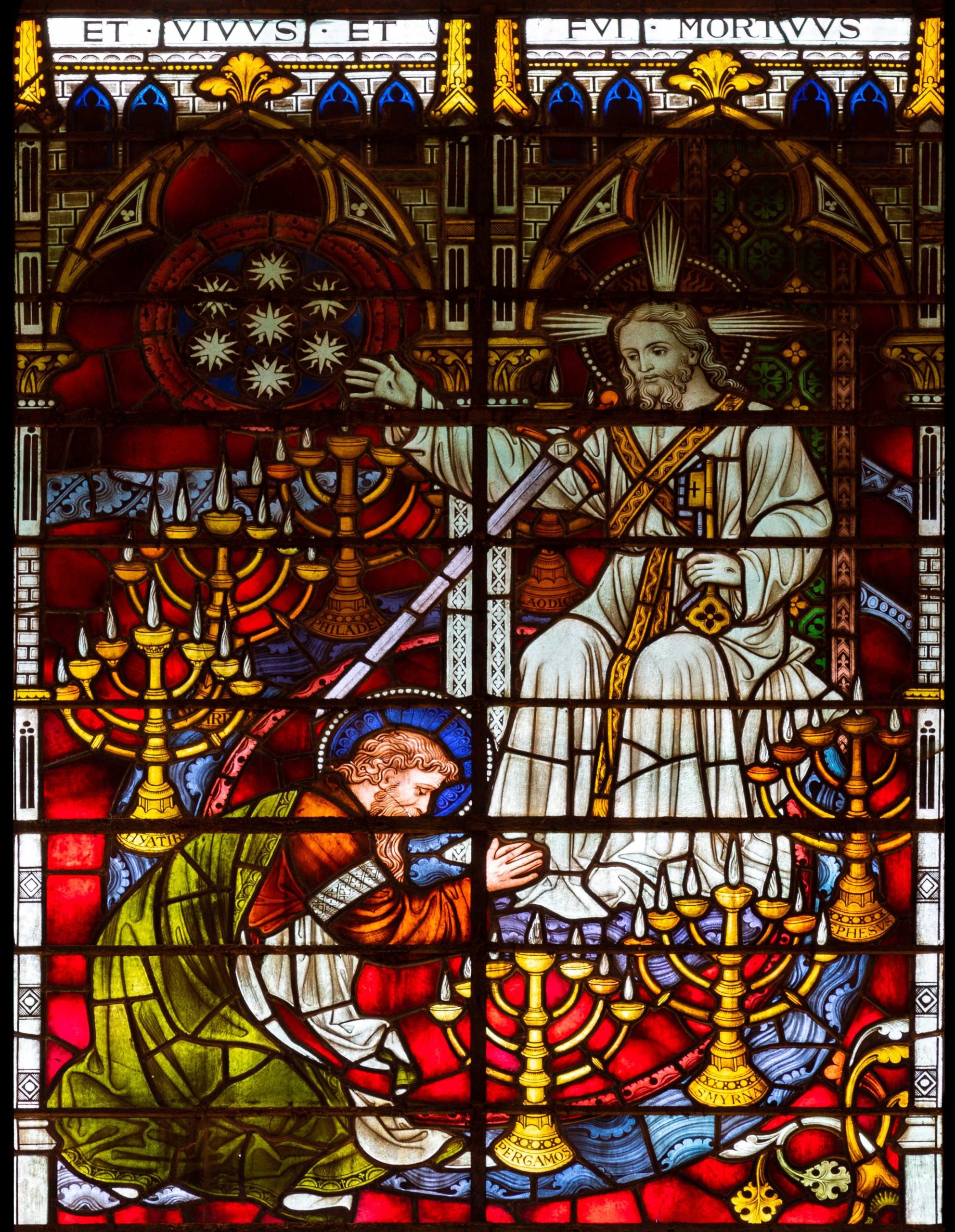
‘Come up here’: Revelation and the weirdness of God
A sermon by Kenneth Padley
Revelation 4
It’s a funny thing about us God-botherers, but we spend remarkably little time talking about the almighty. When we come to Church, we are likely to hear sermons about the life of Jesus, the mission and worship of the Church, contemporary affairs, or issues of lifestyle and ethics. Some churches devote energy to the Holy Spirit, others to the mechanics of salvation, yet others to the ministry of saints. But how often, I wonder, do we reflect on the existence and nature of God?
Passages like Revelation chapter 4 won’t let us duck the question. So what are we to make of the words which we have just heard?
Revelation is a notoriously whacky and controversial book. Its inclusion in Scripture was challenged even in the earliest centuries. And its meaning is disputed because there is no neat formula for decoding its complex symbolism. Indeed, the imagery of Revelation is deliberately multilayered and open-ended.
Having said that, I have found the most useful key for unlocking this book to lie in recognition of the styles in which it is written. I say ‘styles’ because Revelation is not a book of one genre but three – and sometimes these genres overlap.
- Revelation is apocalyptic, heavenly pictures of present-day realities.
- Revelation is prophecy – an attempt to foresee and foretell the future.
- And Revelation is epistle – a letter intended to circulate specific Christian communities in the late first century AD.
Apocalyptic, prophecy and epistle. Today’s reading initiates a shift from the third to first of these genres. Chapters 1-3 are epistle – micro-letters to seven congregations in what is now western Turkey. Chapter 4, however, transitions from these into the meat of the argument. We heard the opening verse of the chapter ‘after this’ – in other words after the seven micro-letters: ‘after this I looked, and there in heaven a door stood open’. Now that’s apocalyptic for you – the stuff of heaven broken open for us on earth.
Having been granted the vision, John – the author of Revelation hears an invitation to ‘come up here’ and we are told that he finds himself transported by the Holy Spirit. As we read his text, we are privileged to grasp his coattails and are drawn into his celestial vision.
John’s vision is nothing less than divinity itself, the one who looks like jasper and carnelian. That said, I am struck as much by what we are not told as by what we are. The scene is focused on God, but the vision is so overwhelming as to be beyond John’s considerable skills as a wordsmith. He edges around that which he is unable to describe. Here we have a reminder that God is radically Other, always confounding our abilities to comprehend and articulate.
Confronted by God’s radiance, John averts his gaze to the periphery of the scene. He finds himself in a place of much activity and many creatures. Each reveals a little about the central Protagonist.
- We are in a throne room. After all, God is Monarch, the ruler of all.
- Before the throne is something like a sea of glass. Ancient Jews had an abiding fear of water. Fishermen like Jesus’ disciples knew the dangers of the deep and understood them to be an expression of the primeval chaos from which God had called the world into order. Such order is perfected in God’s nearer presence which is why in Revelation 4 the sea has become safe, flat as a mirror, while Noah’s rainbow, sign of restoration after flood, stands above.
- Around the throne John sees twenty-four elders. Their identity is unclear. They may be the twelve patriarchs after whom the tribes of Israel were named, plus Jesus’ twelve disciples. If so, God is surrounded by the old order and the new – all ages, past and future enwrapped in worship.
- Equally tricky are the four living creatures. Later Christians have understood these to be the gospel writers – Matthew as a man, Mark a lion, Luke a bull and John an eagle. However, the writer of Revelation would probably have understood them to represent the totality of creation, four being a symbolic number for the earth – one for each corner. Maybe here we are being reminded that all creatures – not just humans – worship God in ways that are right for them.
- We are in a throne room, but it is more than a throne room. Revelation 5.1 tells us that this is a place where scrolls are read. We are being invited to picture a synagogue. Remember that Christians would not have met in church buildings at this time, our tradition having evolved out of Judaism. In this metaphor, God is a teacher, with a holy message for the world and for each of us.
- Later again, in chapter 8 verse 3, we are told about the burning of incense; we are meant to imagine ourselves in a Temple. God is the only rightful object of our sacrifice of praise and thanksgiving.
- Finally, the vision includes elements of a lawcourt in which the advocate for the prosecution is defeated – that’s chapter 12 verse 10. The King who sits on the throne is also a judge, one who through the cross of Jesus (most wonderfully) chooses to acquit us of all our mistakes.
The book Revelation is thus a depiction of John’s powerful encounter with God. Few if any will ever have an experience like this. Nonetheless, for many Christians, personal encounter is an important grounding of faith. Maybe there are times when you have felt invisibly held, supported, guided, guarded. For some this experience might come through nature; for others it might lie in silence or art or music; for others it might be seen in the love of another person. If you have been blessed with such moments, then cherish them as much as John treasured the visions of Revelation.
Religious experiences are very significant for those who have them – but they are uniquely personal. We cannot verify or validate all our emotions, let alone those of anyone else. My experience may convince me about the existence of God but for exactly the same reason it may fail to convince you. It is, after all, my experience.
This is why, alongside treasuring spiritual encounters, Christians should also familiarise themselves with arguments for the existence of God. There are several of these. As some have heard me say before, my favourite is what is known as the ‘cosmological’ argument. This argument asks you to imagine a domino rally. Something or someone must have started the rally. Without someone or something to push the first domino, you have to conclude that the rally is endless, chugging along forever, an endless stream of dominoes. While this is philosophically possible, it feels a little odd.
The cosmological argument applies this image to the universe, noting that everything has a cause in order to ask where the chain of causation came from. You either have to conclude that the chain has always been there – going on and on without explanation – or you must deduce the existence of an uncaused cause – an ultimate reason for all the other causes but which is itself without cause. And this uncaused cause is what we call God.
I like the cosmological argument. No argument can actually prove or disprove the existence of God. However, the cosmological argument shows that theism is cogent and that the alternative (a chain without origin) feels rather unsatisfactory.
It is very easy to dismiss the book Revelation as supernatural claptrap. However, as our Canon Historian Tom Holland has recently observed, it is such peculiarity which makes Christianity distinct. In challenging the liberal trope that Jesus was just a nice guy, Holland says,
If you are a Christian, you think that the entire fabric of the cosmos was ruptured by [a] strange singularity where someone who was a God and a man sets everything on its head… So if you believe that then it should also be possible to dwell on all the other weird stuff that traditionally comes as part of the Christian package. [1]
Revelation invites us to embrace the weirdness, and in so doing find inspiration in the one enthroned in heavenly splendour, who is Father, Son and Holy Spirit. Amen.