
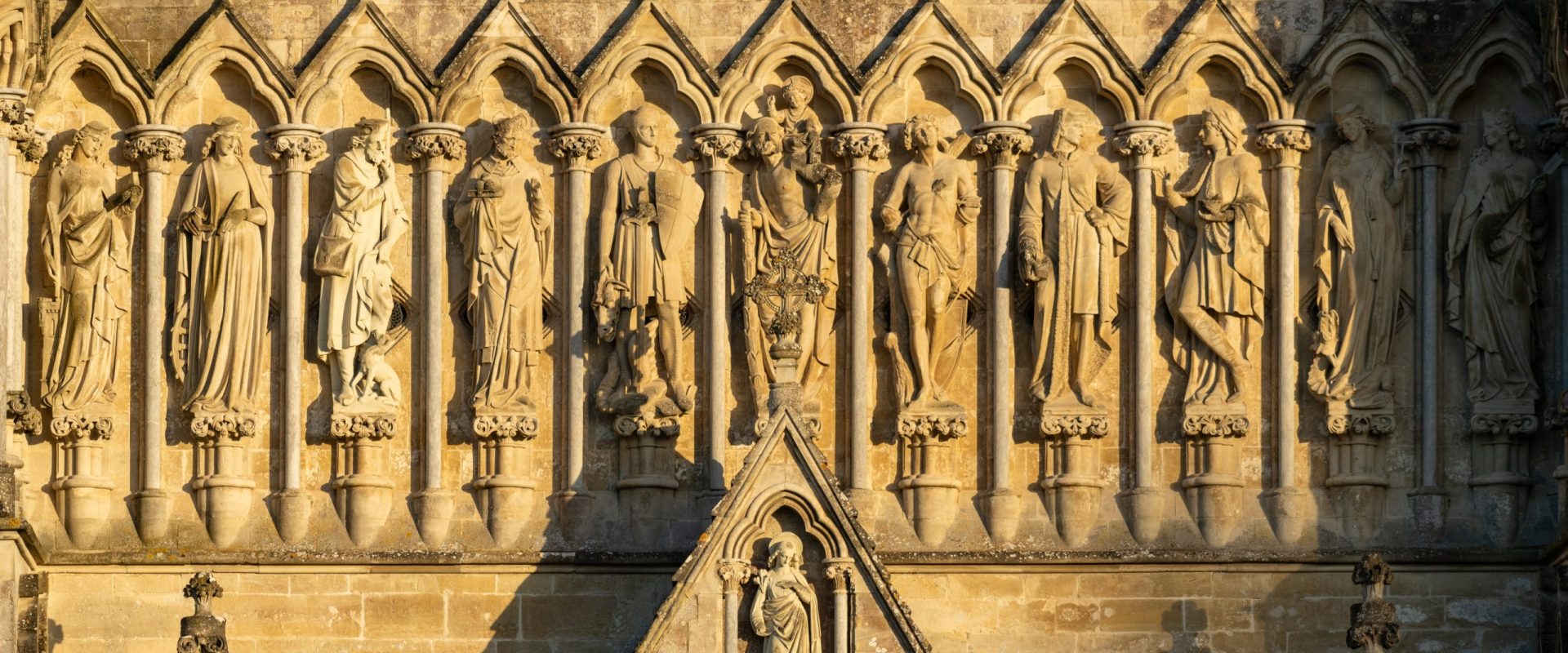
All Saints’ Day
Canon Anna Macham
Sunday 1 November 2026
1 John 3:1-3 and Matthew 5: 1-12
A couple of weeks’ ago, we hosted a talk here at the Cathedral entitled “Everyday Normal” given by Canon Sarah Jones. Sarah is a priest, and was the first person to have made a gender change and then be ordained in the Church of England. Sarah spoke very personally- and with great humour – and boldness – about her journey and described how, initially, she found it hard to reconcile her trans identity with her faith, wondering whether – if God had made her male – she had any license to change that – and whether to do so was sinful. She described an experience early on of going on retreat and speaking to the retreat warden, who, she said, didn’t know anything about transgender people. But his response, when she spoke to him, was, “I know nothing about this, but it strikes me that what you are is God’s gift to you, and what you become is your gift to God”.
To me, this quote gets to the heart of a truth about human identity. It’s easy to think that who we are is fixed – our nature and personalities set from early in our lives, and that we can’t really change it. “It’s just the way I am”, we say – doggedly and a bit through gritted teeth, when someone challenges something we’ve done. But we also cling on to the idea that it’s possible to change who we are and become something different – even if to such an extent sometimes that this isn’t particularly realistic. To reach fulfilment and happiness in life, and to do some good to others, it must be possible for us to grow and learn, and develop, and at least part of this, we hope, must involve successfully changing our attitudes or behaviours and refining some aspects of ourselves.
Being and becoming: the reason I think, why the retreat warden’s words to Sarah Jones resonated so powerfully with me and our audience is that they acknowledge the tension between the two, affirming both simultaneously, and giving them equal weight and value. In my own experience, it’s only at times when I’ve accepted something about who I am that I don’t like – a perceived limitation – that I’ve then been truly able to become something else, or develop a new sense of confidence to do something I was afraid I couldn’t do before. Presumably the same is true for Sarah Jones too – having her gender confirmation surgery was clearly the right thing for her, yet – while a big step and a change – it affirmed the person she knew herself to be from the very start.
How to hold these two aspects together – truly accepting who we are whilst being open always to become something else, or a better version of ourselves, never standing still, is the task of a lifetime – and of Christian discipleship. And crucially, insights in this area often involve other people, whether an unusually empathetic stranger, like the retreat warden, or our friends.
Much of our experience of Christianity has been mediated to us historically through the lens of the individual. At the Reformation, when the Church of England was formed, this was from the perspective of our individual autonomy or personal sinfulness. But today’s Festival of All Saints affirms how embedded the community is in our faith. It acknowledges our debt to the great cloud of witnesses, the saints, who have gone before us. The Mexican-inspired “day of the dead” when people gather to remember the dead and celebrate, drinking tequila in graveyards, isn’t just an excuse for a party, but actually reveals a serious point, which is how connected we are with others, namely those who have gone before, and just how deeply their lives have touched ours.
And what of the saints who are still alive? The Covid pandemic reminded us powerfully that, when we pray, we’re united virtually and spiritually with living saints all over the globe in the mystical body of the Church- an awesome fact to contemplate. And the reverse is true as well – when we do physically encounter other Christians across the world whilst attending worship abroad in other countries, we automatically share common assumptions, beliefs and practices, for better or for worse sometimes! – even if we don’t speak a word of the same language.
All Saints reminds us, too, of the ordinariness of the saints. When my dad died, I didn’t find some of the imagery of the Church helpful – picturing of him as one of the white-robed army in heaven didn’t fit with how I wanted to think about him or remember him at all, especially in the very early days of grief. Yet, while the Feast of All Saints was originally named as such in 609 by Pope Boniface IV in honour of the Virgin Mary and All Martyrs, it subsequently expanded to include more ordinary saints too- those who had no designated saint’s day of their own. In that way, for all the elevated imagery contained within our liturgy today, All Saints has always been a low-key festival, a day to acknowledge and remember the hidden saints- not the big names, but those who aren’t included in the official canon – people more like those we will remember tomorrow, on All Souls, who have moved us on a more personal level by their quieter, less public displays of courage, and willingness in their own, more modest and unseen way, to put their faith into action and follow Christ.
The saints we celebrate today – living and departed – are ordinary people, people like you and me who, in their everyday lives practise the Beatitudes, or “beautiful attitudes”, Jesus describes in the Sermon on the Mount, who work humbly for a more just and better world, and who lead a way of life and witness that is authentic and in tune with God’s kingdom. Being a saint isn’t about becoming someone or something we’re not. It’s about becoming who God made us to be. And that means we’re all called to be saints in different ways, and to ask ourselves what that looks like in the particular circumstances of our lives. In my situation, how would Jesus act? How would he be?
One of the reasons why the Beatitudes are of such fundamental importance at the start of Matthew’s Gospel is that they call us to have integrity, to live the faith we have received. In that way, they anticipate the Great Commission with which the Gospel concludes: “Go…and make disciples” (Matthew 28:19). But each of us can only do this from the place in which we are, and through our own particular experiences of life. Above all, the Beatitudes are about being authentic in our faith and living what we say. Matthew’s Gospel is often regarded as the so-called “spiritual” gospel compared to Luke’s, but his beatitudes present justice and peace as things to be done, putting our beliefs as Christian disciples into practice and acting on them in the community.
In honour of her courage in being the first and her work speaking publicly about her experience, Sarah Jones was honoured with a Pride Award five years ago by the LGBTQ publication Attitude Magazine. Yet as the title of her talk implies, “Every day normal”, she comes across as a ordinary, relatable person, someone you would like to know. The fact that she’s able to speak about her experience in prominent churches and Cathedrals like this one shows how, despite the headlines, the Church is moving forwards on this issue. It was particularly heartening to see so many young people present at talk given by a member of the clergy, and a number of members of the city’s secular LBGT group, for whom the Church would not be seen as a natural ally.
I think that it must cost Sarah Jones something to speak in the way she does. And yet she is only doing what we’re all called to do – witnessing to Christ present in her own life, and moving people and helping them, including those who have previously been alienated by Church, as a result.
As mentioned, the Feast of All Saints was originally a feast to honour martyrs. Yet the word “martyr” just means “witness”. Whoever we are- quiet or loud, shy or gregarious, whatever our background or sexuality – All Saints reminds us that this is what Jesus calls all of us to be – people who are willing to become the people God has made us to be and who have the courage to tell the truth that is in us.